At the Restaurant Finance & Development Conference, AI was everywhere. So were conversations about changing consumer behavior, labor, capital allocation, data and operational efficiency.
But across the sessions we attended and the conversations we had at the Kalibrate booth, one theme consistently rose to the top: restaurant brands still want to grow, and new store growth remains one of their most important investments.
The challenge is making sure those investments pay off.
For restaurant brands opening dozens or even hundreds of new locations, getting restaurant site selection right has always mattered. In today’s environment, the cost of a poor location is harder to absorb, while the data and technology available to evaluate those decisions continues to improve.
Here are four themes that stood out from the conference.
1. AI for efficiency gains, but people still own the decisions
One of the most interesting discussions came during the AI in Restaurant Finance: What’s Real and What’s Ready session.
The consensus wasn’t that AI is going to replace finance teams or make major investment decisions on its own. Humans will still be accountable for board presentations, taxes, financial reporting and ultimately the decisions a business makes.
Instead, the opportunity is to use AI to eliminate manual work and help people make sense of increasingly large amounts of information.
Miguel’s Jr., for example, discussed bringing customer data, customer sentiment and labor data together in Snowflake, then connecting that information to Claude so teams can analyze different parts of the business together rather than in isolation.
That distinction matters.
The value of AI isn’t simply having access to a model. It’s connecting technology to the right business data and using it to answer meaningful questions.
For restaurant development teams, the same principle applies to restaurant site selection. AI can help teams analyze markets, compare locations and work through large volumes of data faster. But the quality, relevance and recency of the underlying data still determine the quality of the analysis.
2. For growth-oriented restaurant brands, every new location matters
The connection between AI and restaurant development became especially clear during comments from CapitalSpring’s Jim Balis.
CapitalSpring focuses on growth-oriented restaurant businesses where a new location can require roughly $750,000 to $1.5 million to open. When that much capital is going into each new restaurant, the success of net-new units becomes critical to the performance of the business.
That puts site selection and development risk squarely in the spotlight.
The question isn’t simply, “Where can we open next?”. It’s:
- Which markets have room for the concept?
- Where are the right customers today?
- How are those markets changing?
- What level of sales can a proposed location realistically support?
- How might a new restaurant affect nearby existing locations?
- Which opportunities justify the capital required to open them?
AI can make answering those questions faster and more accessible, but the objective hasn’t changed: reduce uncertainty before committing capital to a new restaurant.
3. Scale only works when the infrastructure behind it is ready
That idea carried into the session on emerging restaurant brands and scaling.
Authentic Restaurant Brands shared a simple warning: “Brands don’t die from growing too slow.”
Before accelerating expansion, restaurant companies need an operating model capable of supporting that growth.
For Authentic Restaurant Brands, that includes giving its concepts access to data and analytics that can inform decisions ranging from menu optimization and pricing to broader business performance.
Casina Hospitality offered a similar lesson from the people side of growth. With 17 units, the organization focuses on having management training and leadership infrastructure in place before opening the next restaurant. A new building doesn’t create the leadership required to operate it successfully.
Restaurant growth therefore isn’t purely a real estate exercise. Successful expansion requires the location, operating model, people and economics to work together.
4. Growth decisions need current market data
Another point that stood out was the importance of understanding what a trade area looks like now, not several years ago.
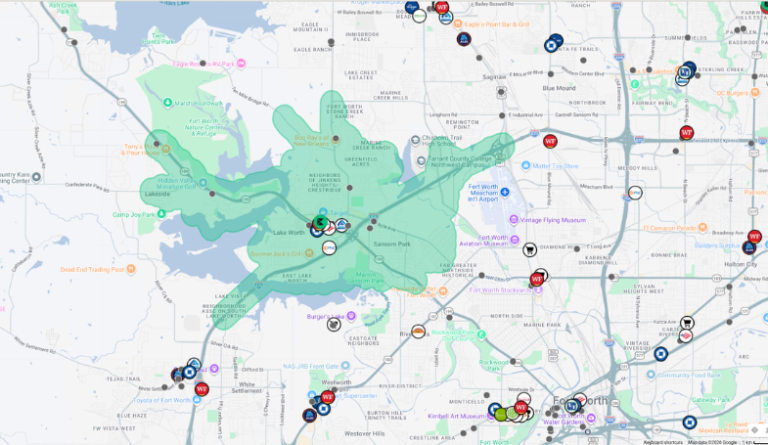
Dallas-Fort Worth offers a good example.
Markets such as Frisco, Anna and other fast-growing communities in North Texas can change substantially in a short period of time. Population growth, housing development, traffic patterns, retail activity and competitive supply can all alter the characteristics of a trade area.
If a restaurant development team is evaluating one of those markets using information from 2023, it may be making a 2026 investment decision based on a market that no longer exists in the same form.
That’s why up-to-date site selection data matters so much, particularly in fast-growth markets.
Historical performance data remains valuable, but development teams also need visibility into where consumers live and work today, how they move through a market, what they spend, the competitive landscape and where future development may shift demand.
The consumer is changing, but restaurant brands aren’t backing away from growth
The CFO panel featuring leaders from Cava, Taco Bell, and Swig added another dimension to the conversation: growth must happen while consumer behavior is changing.
Cava discussed expanding into markets with lower median household incomes than its traditional trade areas and seeing locations outperform expectations. Rather than competing primarily through value offers, the brand is emphasizing the accessibility, quality and amount of food customers receive.
The discussion also reinforced how important those first locations in a new market can be. A restaurant isn’t only generating sales. It is establishing the brand’s position with consumers in that market.
Taco Bell discussed serving a customer base that includes a significant share of lower-income households, using $5, $7 and $9 value meals alongside loyalty programs such as the Tuesday Drop.
Swig, meanwhile, talked about capital allocation more directly. Its priority is new store growth, followed by retrofits and remodels. Company-owned stores also give the brand an opportunity to test ideas before introducing them more broadly to franchisees.
Different concepts. Different consumers. Different strategies. But none of them suggested growth was no longer important.
The bigger question was how to deploy capital intelligently while adapting to the customer and the market.
Restaurant site selection remains a risk-management decision
That may be our biggest takeaway from the Restaurant Finance & Development Conference.
There are more tools, more data, and more AI capabilities available to restaurant brands than ever before. But those technologies ultimately need to support a very practical business objective:
Put capital behind the locations most likely to succeed.
That means understanding not only where a concept’s target customers are, but how a market is changing, what competition exists, how consumers behave and whether projected performance supports the investment required.
It’s also why restaurant site selection was the topic we heard about most often at the Kalibrate booth.
Restaurant brands want to grow. Investors want their portfolio companies to grow. Franchisees want new-unit economics that work.
The appetite for expansion hasn’t disappeared. What’s changing is the level of intelligence teams can bring to those decisions and the expectation that every new location can be supported by a clear, data-backed rationale.
For an industry investing significant capital in its next generation of restaurants, growth and risk aren’t opposing ideas. The opportunity is to get better at managing both.