The outlook for retail real estate is improving, but a stronger property market doesn’t automatically translate into better opportunities for every retailer.
According to Retail Insider’s coverage of PwC’s Emerging Trends in Real Estate 2027 report, confidence in retail property remains strong despite concerns about consumer spending, economic uncertainty, and the pace of new store openings.
One particularly interesting finding is that planned new store openings in 2026 are approximately 15% lower than in 2025. While retailers remain committed to physical locations, their approach to expansion appears to be becoming more selective.
For Kalibrate, this reinforces an important shift in retail real estate strategy: growth is increasingly about the quality of locations rather than the quantity of openings.
A stronger property market doesn’t mean every location is a good investment
The report highlights a disconnect between confidence in retail real estate and concerns about consumer economic conditions. Limited new supply has supported property fundamentals, but the underlying demand for individual retail locations remains subject to significant variation.
For retailers, this distinction is critical. A market experiencing strong leasing demand or low vacancy rates isn’t necessarily a market where a particular brand can achieve its sales and profitability targets.
Consumer demographics, spending behavior, competitive intensity, accessibility, and existing store coverage all influence the potential performance of a location. Two seemingly comparable properties within the same market can deliver very different commercial outcomes.
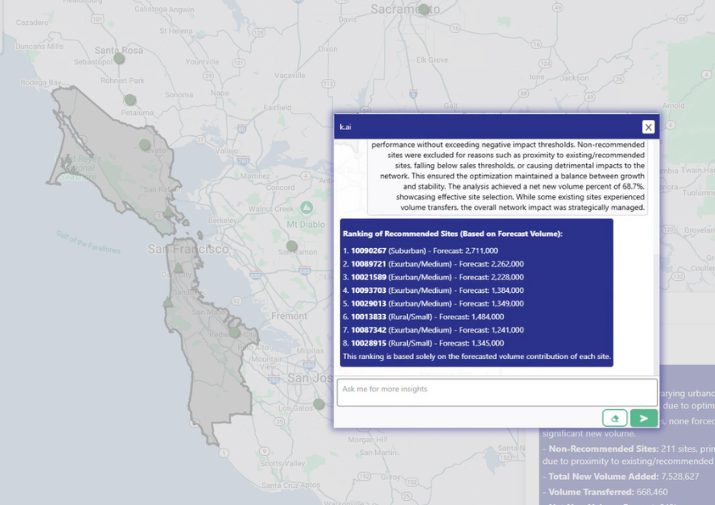
This is where location intelligence becomes increasingly valuable. By combining market data, customer insights, and predictive analytics, retailers can look beyond broad property trends to understand the demand potential of individual trade areas and sites.
More selective expansion requires better forecasting
One of the most significant observations in the PwC report is the growing emphasis on quality over quantity in retail expansion, with more sophisticated analytical tools influencing site selection decisions.
This reflects a broader change in how retailers approach network growth. Rather than pursuing aggressive store count targets alone, operators are increasingly focused on identifying locations capable of delivering sustainable returns.
Accurate sales forecasting plays an important role in this process. Understanding a proposed location’s likely performance, the time required to reach maturity, and its potential impact on existing stores allows retailers to make more informed investment decisions.
Equally important is understanding where opportunities exist across the wider market. Whitespace analysis can identify areas where customer demand is sufficient to support additional stores, helping retailers prioritize investment and focus real estate teams on the strongest opportunities.
As competition for desirable retail properties increases, having this intelligence before entering negotiations can provide a meaningful advantage.
The importance of understanding local market differences
The report also highlights the increasingly divided nature of retail, with value-oriented shopping centers and premium, experience-led destinations responding to different consumer needs.
This reinforces why national or regional economic indicators can only tell part of the story.
A retailer’s performance depends on how well its proposition aligns with the customers and competitive environment surrounding each location. Changes in household income, population growth, consumer mobility, and local competition can create opportunities in one trade area while weakening demand in another.
Retailers must also recognize that the assumptions underpinning their existing expansion strategies may no longer reflect current market conditions. Regularly refreshing forecasting models with contemporary customer, competitor, and market data is essential to maintaining confidence in investment decisions.
Turning market optimism into profitable growth
The improving outlook for retail real estate is encouraging, particularly after several years of economic uncertainty. However, it also raises the stakes for retailers competing for a limited supply of attractive locations.
The challenge for 2027 won’t simply be finding available real estate. It will be identifying which opportunities offer the strongest long-term commercial potential, understanding the risks associated with each investment, and allocating capital accordingly.
At Kalibrate, we see location intelligence and predictive analytics as fundamental to answering these questions. The ability to quantify demand, evaluate competitive dynamics, and forecast location performance gives retailers a stronger foundation for making decisions in both growing and challenging markets.
The retailers best positioned to capitalize on renewed confidence in physical retail won’t necessarily be those opening the most stores. They’ll be those making the most informed decisions about where, when, and how to grow.