Choosing the right location intelligence partner could be one of the most important decisions you make when growing or optimizing your real estate portfolio. But with so many providers offering everything from data and AI mapping tools to predictive analytics and consulting services, what should you actually look for?
For decades, we’ve worked with organizations across retail, restaurants, grocery, healthcare, services, fuel and convenience, from growing concepts opening new locations to international brands managing established portfolios. Along the way, we’ve learned a few things about what makes a location intelligence partnership successful.
Here are our top five things to look for when choosing a location intelligence partner.
1. Data capabilities
Data is the starting point for insight-driven decisions, but more data does not automatically mean better decisions. The real value comes from bringing together the right information and understanding which inputs matter most to the question you’re trying to answer.
Your own sales, customer and location performance data can become considerably more valuable when analyzed alongside third-party sources such as demographics, consumer segmentation, points of interest, mobility and traffic data.
When evaluating a location intelligence partner, consider how easily you can bring your own data into its platform and combine it with other sources. Look at the breadth of third-party data available in a partner’s platform, but also whether you have flexibility to incorporate the sources that make the most sense for your business.
Your internal data may also need to be processed, normalized or validated before it can be used effectively alongside other datasets. A strong partner should be able to help you understand what data you need, where gaps exist and which third-party sources can add meaningful context.
Consider asking:
- Can we integrate our existing first-party data?
- What third-party datasets are available?
- How is our internal data processed and validated?
- Can different sources be analyzed together?
- Can our data environment evolve as our needs change?
- Do you have an API for routine data feeds?
Ultimately, look for a partner that helps you get more value from your data, rather than simply giving you access to more of it.
2. Platform functionality
There are plenty of location intelligence platforms to choose from, but functionality only matters if your team can actually use it to make decisions.
Interface and visualization
Does the platform make it easy to visualize your data? Is the interface intuitive and quick to navigate? Can users easily view locations, competitors, customers, trade areas and other market characteristics?
Bear in mind that your team may use the platform every day. If the user experience is clunky or slow, that impact adds up over time.
Self-service capabilities
Ask what your team can accomplish independently. Can users explore markets, evaluate opportunities and run scenarios themselves, or does every new question require support from the provider?
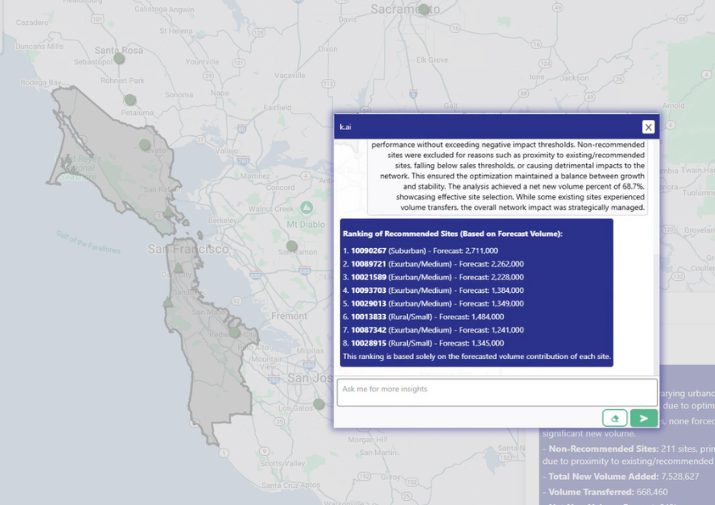
Kalibrate’s Market Optimizer, for example, is a self-service capability that allows users to run market infill and expansion scenarios, setting factors including sales forecast minimums, cannibalization tolerance and spacing allowances, with recommended locations displayed on the map and results available for download.
AI integration
With more location intelligence providers touting AI-powered or AI-native platforms, look beyond how prominently AI features in the technology and consider the value it provides to users. AI should make complex analysis easier to understand and act on, not simply add another layer of technology. In KLI, AI helps distill large amounts of data into a more accessible format, explain the factors driving a site’s sales forecast, and help users quickly analyze market conditions or compare multiple sites. The important question isn’t whether a platform was built on AI, but how effectively AI helps your team make location decisions.
Collaboration and accessibility
Depending on the size of your organization, multiple teams may need access to location intelligence. Ask whether projects and information can be shared between users, whether access and permissions can be controlled, and whether teams can access information away from the office.
This becomes especially important if location intelligence is useful beyond the real estate department. Kalibrate materials identify applications across operations, marketing, franchise development, merchandising, construction, strategy and M&A, real estate and the C-suite, with the ability to control access across individuals and departments.
Scalability
Finally, think beyond what you need today. Can the platform accommodate additional users, markets, datasets and business questions as your organization grows? Does it allow you to manage multiple brands you own or multiple clients from a single login?
The right technology shouldn’t just solve today’s problem. It should be able to evolve with your location strategy.
3. Analytics and expertise
There’s an important difference between displaying location data and understanding what that data means for your business.
Strong location intelligence should help you answer increasingly complex questions. Where should we grow? How much could a proposed location sell? How could a new opening affect nearby locations? How much additional white space exists in a market? How many locations could that market potentially support?
Kalibrate’s location intelligence capabilities include predictive forecasting, cannibalization and recapture assessment, site selection and scenario reporting, and whitespace and supportable unit analysis. Other Kalibrate materials reference market optimization, territory management and portfolio analysis.
When predictive analytics, AI, or machine learning are involved, explainability also matters. A forecast or score becomes much more useful when your team understands the factors influencing it and can explain the recommendation to other stakeholders.
Kalibrate’s modeling materials describe analytical outputs grounded in location intelligence factors including trade areas, customer profiles, competitive landscapes and site attributes, with those drivers carried through from inputs to outputs to support transparency.
It’s also worth considering the balance between software and human expertise. This doesn’t necessarily have to be an either/or decision.
A self-service platform can give your team speed and independence for recurring decisions, while experienced analysts can provide additional support for more complex modeling or strategic questions. Kalibrate’s materials, for example, describe predictive forecasting models being developed and then integrated into KLI so users can apply those models to new-site scenarios within the platform.
Ask potential partners:
- What analysis can our team conduct independently?
- When would your analytics team become involved?
- Can you build analysis around our specific business and objectives?
- If a custom model is developed, can we use it for future decisions?
- How do you explain the factors driving forecasts and recommendations?
The goal is to find the right combination of technology and expertise for your organization, rather than forcing your team into one way of working.
4. Industry expertise
Different industries and business models have different market dynamics, customer behaviors and location requirements. A restaurant evaluating drive-thru locations isn’t solving exactly the same problem as a specialty retailer, grocery operator, healthcare provider or franchise organization.
That’s why industry expertise matters.
Look for a partner that understands how different factors influence performance within your sector and can distinguish meaningful trends from noise. The analysis should reflect your concept, customers, competitive environment and growth strategy rather than applying the same generic methodology to every business.
Industry experience can also help a partner understand the broader questions surrounding an individual location. A site may look attractive in isolation, for example, but what does it mean within the wider market? Is there room for additional growth? How could the location affect existing units? How does the competitive environment change the opportunity?
The right partner should understand not only where something is happening, but why it matters for your particular business.
5. A proven track record
Trust underpins all of the above. Can a partner really do what they say they can do?
A history of successful projects can give you confidence that a provider has the experience to address your requirements. But don’t stop at logos on a website. Look for evidence that the provider has solved problems comparable to yours.
Ask questions such as:
- How long do your client relationships typically last?
- Have you worked with businesses like ours?
- Can you share relevant client stories or examples?
- Can we speak to an existing client?
- What does the relationship look like after implementation?
Testimonials and references can also provide useful insight into a partner’s working style, effectiveness and ability to deliver value over time.
A successful track record is particularly valuable when it includes experience with challenges similar to your own. That familiarity can mean the partner already understands many of the data challenges, analytical questions and strategic considerations associated with your situation.
Choosing the right location intelligence partner
Ultimately, choosing a location intelligence partner isn’t about finding the provider with the most data, the longest feature list or the newest technology.
It’s about finding the right combination of data, platform functionality, analytics, industry expertise and proven experience for the decisions your organization needs to make.
The right partner should help your team turn complex location data into practical answers, whether you’re evaluating a single site, identifying markets for expansion, understanding cannibalization, assessing white space or optimizing an established portfolio.
And as your portfolio and strategy evolve, your location intelligence partner should be able to evolve with them.