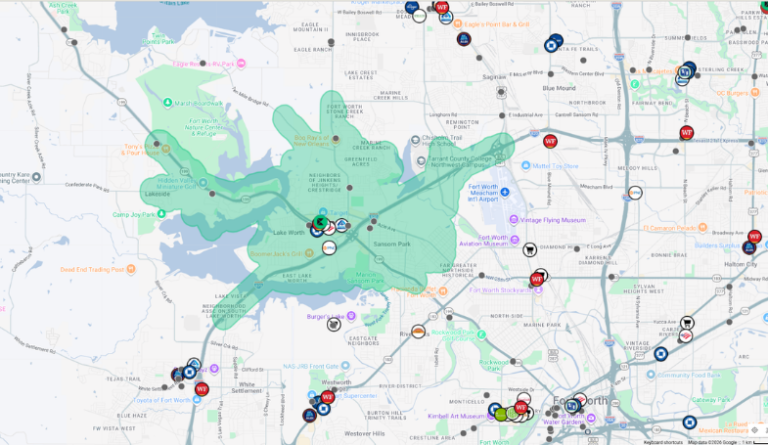
Point of Interest (POI) data is one of the most widely used datasets in market planning, site selection, and sales forecasting. By providing location information for retailers, restaurants, banks, healthcare providers, and other businesses, POI data helps organizations better understand the competitive and commercial landscape surrounding every location.
Through partnerships with providers such as RetailStat, ChainXY, and Hubexo, Kalibrate offers access to a range of POI datasets that can be used alongside demographic, mobility, and customer data to support growth decisions. While competitor mapping is often the first use case organizations associate with POI data, the dataset can provide value across many aspects of market planning and portfolio strategy.
Below are several ways organizations use POI data to better understand markets, evaluate opportunities, and improve decision-making.
Identify competitive pressure
POI data allows retailers to be aware of where all of their direct and indirect competitors are located. This can assist with new store site selection (identifying locations that are less likely to be impacted by a strong competitor), and with crafting pricing, marketing, and operational strategies at a store level by being sensitive to the impact of nearby competition.
Evaluate co-tenancy opportunities
In addition to providing locations for all relevant competitors, POI data can help retailers identify those synergistic retailers who they would prefer to locate next to. Selected retail concepts, including apparel retailers, shoe stores, jewelry stores, and restaurants can benefit from being located in the same center as or close to direct competitors, by providing consumers with a more compelling destination that provides the opportunity to easily cross-shop different brands.
Some retailers also find that locating near complementary concepts can be of benefit – a high-end women’s apparel chain may find that locating next to shoe stores and accessory stores helps to enhance sales performance.
Kalibrate evaluates co-tenants as a matter of course when developing a sales forecasting model on behalf of a client and quantifies the impact that the presence of a specific operator (such as Home Depot) or a general category (such as home improvement) has on unit performance. While co-tenancies are generally not the most important consideration when determining where to deploy new stores, this information can be of great value to real estate directors and managers deciding between two or three shopping center locations to serve a market.
Monitor planned developments and openings
Looking at current business locations only tells part of the story. Planned opening data can help organizations understand how competitive and commercial landscapes are likely to change in the coming months and years.
RetailStat and ChainXY provide visibility into announced retail and restaurant openings, helping organizations identify areas where competitors or complementary operators are expanding. This information can help real estate teams evaluate opportunities, anticipate future competition, and better understand emerging retail activity.
For organizations looking further ahead, Hubexo provides a complementary perspective. Rather than tracking individual chain locations, Hubexo monitors planned residential, commercial, and mixed-use developments across the United States. This visibility can help identify markets where population growth, new housing, and commercial investment may create future demand for retail and restaurant concepts. With more than 100,000 commercial and institutional projects tracked, including over 75,000 with a retail component, Hubexo can help organizations uncover opportunities before they become obvious in traditional market metrics.
As with any planned development dataset, visibility is generally limited to projects that have entered the public domain. Projects in the earliest stages of planning may not yet be reflected.
Learn from historical openings and closures
At first glance, knowing when a competitive store opened or closed in the past may not seem to be particularly relevant in planning for the future. However, it can be of great value in quantifying the impact that prior openings or closures have had on comp sales performance, which can help finance teams account for the impact of future openings and closures on projected sales and profitability.
Kalibrate has conducted global studies for US-based retailers and restaurants which have started to or are contemplating expanding on a global level. This can be a challenging exercise, in part because much data (such as demographic and psychographic information) is not consistently measured from country to country and can be quite expensive, and because tastes and preferences vary by region.
Support expansion planning and unit growth analysis
Global POI data can provide an independent means of estimating how many stores can be supported, by assessing the global footprint of complementary retailers who have expanded beyond the US. As an example, a US-based burger chain might look at McDonald’s deployment by country, or a supermarket chain might quantify the number of full-sized supermarkets in each country. This information alone will not provide a definitive projection, but represents a valuable double-check on projected store counts by country.
This approach can also be used by US companies as a means of establishing or validating expansion plans. As an example, a restaurant chain that finds they typically have 60% of the unit count of a direct competitor in markets where both operators are fully built out can use that relationship to estimate or confirm the desired number of openings in other markets where that competitor has a mature deployment.
While POI data is often associated with mapping competitors, its value extends much further. From understanding co-tenancy relationships and monitoring market changes to supporting sales forecasting and expansion planning, POI data provides important context for evaluating opportunities and reducing risk.
When combined with other market intelligence datasets, POI information helps organizations move beyond assumptions and make more informed decisions about where to invest, grow, and compete. As a result, it remains one of the most versatile and widely used datasets available to real estate, market planning, and strategy teams.