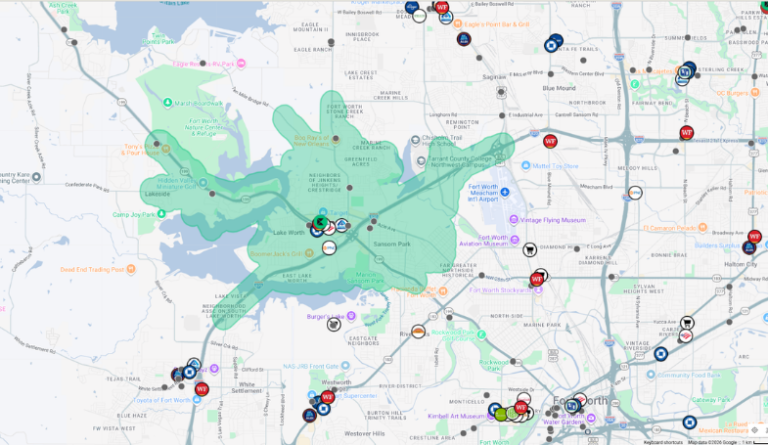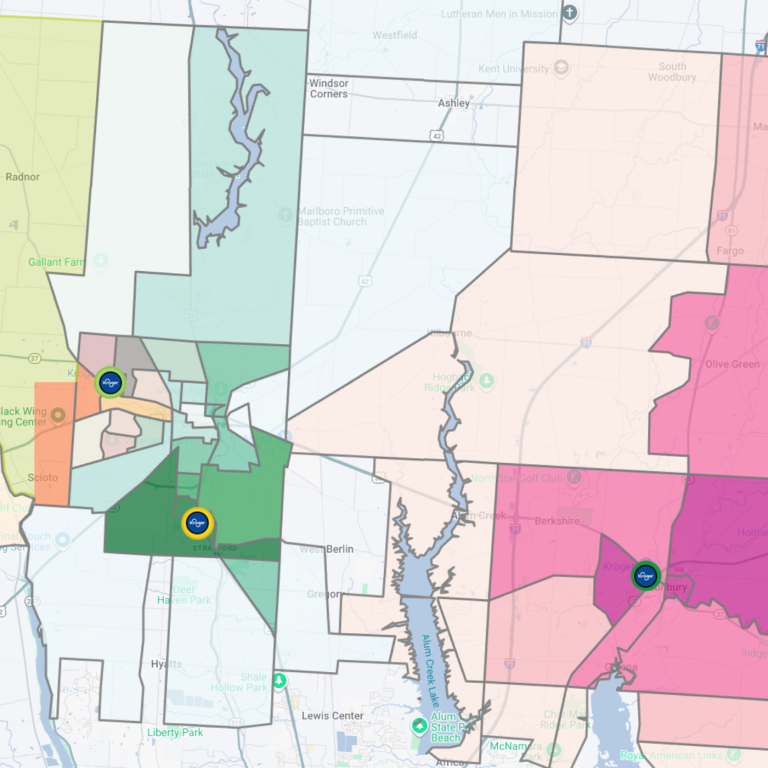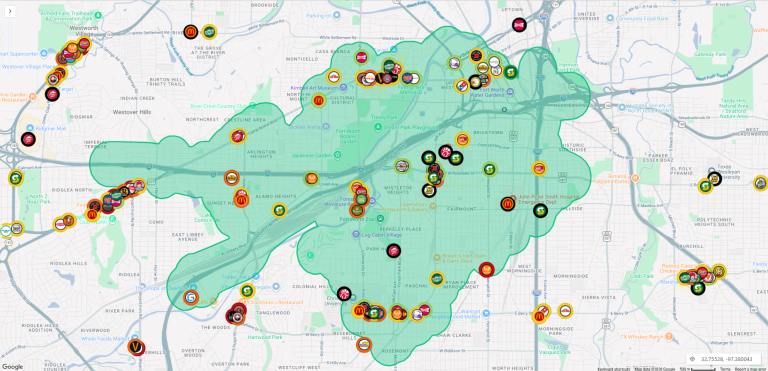
Mobility data has become one of the most valuable data sources available to retailers, restaurants, and other consumer-facing businesses. Providers such as Azira help organizations better understand customer behavior by revealing where visitors come from, which locations they visit, and how movement patterns change over time. These insights support a wide range of business decisions, from market planning and site selection to sales forecasting, network optimization, and competitive analysis.
For operators without access to customer address data, mobility data can provide a reliable view of customer trade areas and visitation patterns. It can also help quantify cannibalization risk, identify cross-shopping behavior, evaluate co-tenancy opportunities, and benchmark store performance against competitors. Few data sources offer the same combination of geographic coverage, behavioral visibility, and speed.
Before exploring these applications in more detail, it is helpful to understand how mobility data is collected and the limitations users should consider when incorporating it into their decision-making processes.
Mobility data is generated when consumers opt to share location information through mobile applications. Providers such as Azira aggregate anonymized location signals from millions of devices and use those signals to estimate visitation patterns, trade areas, and consumer movement.
Key applications of mobility data
Customer distribution
Mobility data allows retailers to see where customers are coming from for each of their stores. This is of particular value for operators who do not have ready access to customer address data (quick service restaurants, as one important example). Customer distribution data is a key component in the development of sales forecasting models.
Sales transfer impacts
Mobility data represents an agnostic third-party source for determining where a store’s customers are coming from, and quantifying the projected sales transfer impact from new stores on nearby sister stores. Kalibrate has found this to be a particularly effective data source for quick service restaurants, given the ability to readily collect a full 12 months of data (thereby eliminating any seasonality-related concerns).
Cross-shopping
This data enables a retailer to determine who is cross-shopping their store, including both operators within the same shopping center and other retailers overall. This can be of value in identifying synergistic retailers whose proximity can be a benefit, and determining where a chain’s patrons are cross-shopping for the same products or services.
Shopping center vacances
Shopping center owners and operators with vacant space can determine which new tenant or tenants would be most appropriate for their shopping center based on the projected cannibalization impact on existing sister stores.
Comp visit trends
Mobility data can be used to compare and contrast visit trends between specific stores and/or specific chains. Because mobility data is available on a daily or weekly basis (depending on the provider), the result is a very contemporary assessment of activity.
Key limitations of mobile data
Multi-story locations
Mobility data accurately identifies visits within a geographic boundary but cannot reliably distinguish activity across floors. This makes it well-suited for freestanding and single-story locations, but less effective in mixed-use developments or high-rise buildings.
Short visits
Visits of only a few minutes may not always be captured, depending on the frequency of location observations. This can impact analysis of businesses where customer dwell times are typically very short.
Customers vs employees
Mobility data measures device presence, not visitor type, making it difficult to separate customer visits from employee activity.
Transaction value
Mobility data measures visitation patterns but cannot determine whether a visitor made a purchase or the value of that transaction.
Sample-based data
Mobility data represents a sample of opted-in devices rather than all consumers. While providers use methodologies to project broader behavior, results should be viewed as directional rather than exact counts.
Government regulation
We couldn’t publish this article without addressing the ongoing regulatory landscape for mobility data. While federal oversight remains limited, states have increasingly enacted privacy legislation governing location data collection and use.
California set the precedent with the California Consumer Privacy Act (CCPA) in 2018, and about 20 states have followed with similar requirements around consumer consent. Several states, including Connecticut, Maryland, Massachusetts, New Jersey, Oregon, and Virginia, have gone further by restricting or prohibiting the resale of mobility data. Additional legislation is under consideration in California, Vermont, and Washington, making compliance and alternative data sourcing an increasingly important consideration for providers and users alike.
Kalibrate has been leveraging some alternative sources to account for these regulatory changes. In addition to using Azira as one source of mobility data, Kalibrate has long leveraged a proprietary “Trip2Trade” methodology, which relies on connected car data to provide information on aggregate counts and pre/post destination information on drivers. It is important to note that this data is exceptionally valuable when considering a freestanding store or a parking lot, but would not be able to distinguish individual stores in an enclosed shopping mall, for example.
Despite increasing privacy regulation, mobility data remains one of the most effective tools for understanding real-world consumer behavior. When paired with complementary datasets and a clear understanding of its limitations, it can provide retailers with actionable intelligence for market planning, site selection, development, and network optimization.
Interested in seeing how mobile data could benefit your business? Learn more about Competitive Insights, our mobile data platform, or request a demo to see specific use cases for your business type.