Why diversity matters, beyond optics
This isn’t about meeting quotas or ticking boxes. There’s clear evidence that diverse teams perform better.
As Forbes reports, research shows:
- Inclusive teams make better decisions up to 87% of the time.
- Teams that follow inclusive processes make decisions twice as fast, with fewer meetings.
Diverse perspectives challenge assumptions, reduce the risk of groupthink, and ultimately lead to better commercial outcomes.
Fuel retail is a traditionally male-dominated industry. The WPC report, “Untapped Reserves 3.0” reports that as of 2023 women made up 23% of the “wider energy sector” globally, and at senior exec levels in Oil & Gas that drops to just 20%.
Many companies are introducing initiatives to improve this balance but, on the whole, fuel is still heavily male dominated.
It’s not just about leadership
When we talk about diversity in energy, the conversation often centers around women in leadership roles, and rightly so. Representation at senior levels matters.
But one of the clearest themes that came out of our discussion is that focusing only on leadership misses the bigger picture. Few people enter this industry as a senior leader. If we want to see more women at the top, we need to ensure there’s visibility, encouragement, and opportunity at every stage. From entry-level roles through to executive positions.
As the saying goes: you can’t be what you can’t see.
Bain & Company report that in the EU, women have filled 75% of the 8 million new jobs created since 2000. We need to make sure those women see the oil & energy industry as a favorable option.
If young women don’t see themselves reflected in the industry: on forecourts, in commercial roles, in operational teams, and in technical positions. They’ll be less likely to consider the oil and energy industry as a viable career path.
Progress is real, but uneven
From my perspective, having worked in this industry for over 26 years, the change has been significant. When I started, women in our industry in visible or public-facing roles were rare. Today, representation is improving across organizations, at conferences, and in industry discussions.
There are clear signs of progress. Earlier this year, Meg O’Neil was appointed CEO of BP, alongside leaders such as Emma Delaney at OMV and Vicki Hollub at Occidental Petroleum, giving women clear role models within the industry.
But that progress isn’t consistent. Experiences still vary widely.
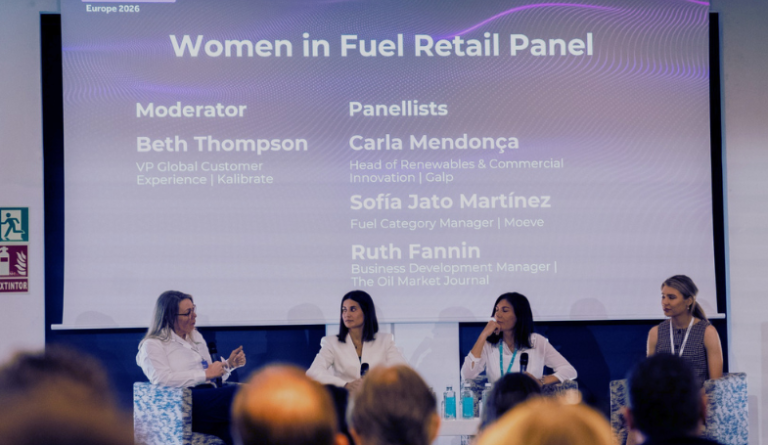
Sofía spoke about university programs in Spain which actively support women to learn leadership and management skills specifically for male dominated industries. This simply didn’t exist a generation ago.
At Moeve, an initiative for 70% of new hires to be female was intentional, to rebalance representation. And at Galp, there’s a conscious move away from “manels” (male only panels) to ensure more balanced perspectives in discussions.
But while the women speaking with me were part of incredibly forward-thinking companies, they still shared similar experiences. When attending external meetings, participating in working groups, and attending industry events: They’re often the only women in the room.
A global perspective
This was a European panel, with perspectives from England, Northern Ireland, Spain, and Portugal, and even within that relatively small geographic scope, the starting points have been very different.
It’s important to recognize that progress doesn’t happen in unison, and not all regions of the world start from the same place. That context should shape how we think about diversity globally: there’s no single solution, and progress will look different depending on where you are.
So, what can we do?
One of the most encouraging aspects of the session was how many people approached us afterwards asking the same question: What can we actually do to make a difference?
There isn’t a single answer, but there are practical steps everyone can take:
- Notice the gaps
If you see a lack of representation, on a panel, in a meeting, at an event — question it.
- Be intentional
Balance doesn’t happen by accident. It requires conscious decisions when organizing events, selecting speakers, or building teams.
- Be a role model
Small actions matter; being visible, supportive, and inclusive early in someone’s career can have a lasting impact.
- Create inclusive spaces
Particularly in male-dominated environments, creating spaces where women feel comfortable connecting, whether that’s through dedicated networking opportunities or informal events, can make a meaningful difference.
- Encourage visibility
Invite women to attend and speak at industry events. Visibility builds confidence and creates momentum.
- Start with awareness
You don’t need to have all the answers. Recognizing the imbalance and understanding why it matters is the first step toward addressing it.
A question that came up was: How do we invite women to speak without making it feel tokenistic?
The answer is straightforward: focus on expertise. There are highly skilled, experienced women across this industry. Including them isn’t about meeting a quota, it’s about recognizing the value they bring.
If we want a more balanced, more innovative, and more effective industry, we need to ensure that opportunities are visible and accessible at every level, not only at the top. Because ultimately, if women can’t see a place for themselves in this industry, they’re unlikely to choose it. And that’s a loss we can’t afford.