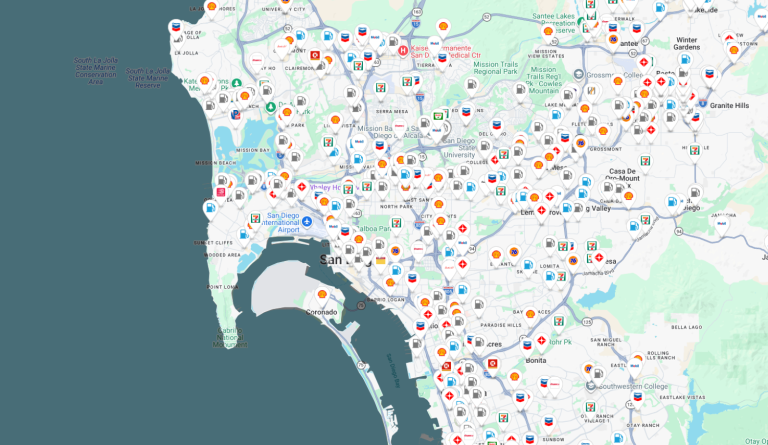
Covering more than 890 open fuel sites, Kalibrate’s market data reveals market structure, brand performance, and the growing importance of convenience retail and foodservice.
By comparing site share, market share, service penetration, and network characteristics across both survey periods, the analysis highlights where operators are strengthening their offer, which brands are outperforming their footprint, and how the competitive landscape continues to shift.
Underperformance, overperformance, and opportunities to improve for all
The comparison between gasoline site share and market share highlights that network size alone does not determine competitive performance.
Chevrons convert its sizeable footprint into an even greater share of market demand, indicating strong site productivity across their networks. Costco remains the clear outlier, capturing a disproportionately large share of fuel demand from a very small number of locations, demonstrating the its pull and a high-volume fuel operating model. In contrast, Shell, 7-Eleven, and ARCO have larger network footprints than their market share would suggest, indicating opportunities to improve site performance rather than simply expand the network.
7-Eleven leads the way
The convenience retail landscape tells a slightly different story. 7-Eleven dominates both store share and c-store market share, reinforcing its position as the leading convenience destination in the market.
ampm also performs strongly, while ExtraMile and Circle K generate a greater share of convenience sales than their network size alone would imply, suggesting an effective retail proposition. Rocket, however, underperforms relative to its footprint, indicating that its stores are capturing a smaller share of convenience spend than competing brands.
QSR’s penetration increases
The overall number of open fuel sites changed very little between our previous survey in 2023, but the composition of those sites continued to evolve. More locations now feature a QSR offer, while the number without foodservice has declined. This reflects an ongoing shift in retailer strategy, with operators increasingly investing in prepared food as a way to attract more frequent visits, increase dwell time, and diversify revenue beyond fuel. Rather than expanding the network, many retailers appear to be enhancing the quality and breadth of the customer offer at existing locations.
Service diversification continues
Foodservice remains the strongest area of investment across the San Diego market. QSR penetration continued to grow, while dispense coffee recorded the largest increase of any ancillary service, reinforcing the importance of beverage-led convenience.
Deli penetration remains exceptionally high and has edged up further, suggesting it has become a core element of the convenience proposition rather than a differentiator. Car wash availability also continued to grow, albeit more gradually, indicating that retailers are still investing in services that encourage repeat visits and strengthen overall site competitiveness.