About five times each year I jump on a plane to the UK to visit our colleagues at our Manchester HQ.
Usually, I fly into London Heathrow and take the train north. The towns we pass en-route bear parallels with many of the urbanized and semi-urbanized areas I see across the US. Their centers have changed.
We know the story. The online shopping disrupted, Covid accelerated, and a normality returned, but not the normality we had before. Centers have had to reposition themselves as destinations while retailers themselves have reoptimized their footprints to take account of the different ways we live, work, and play.
Whole new concepts have followed. Eatertainment, which blends food, leisure, and experience, has moved from niche to mainstream. What started with arcades and fast casual dining now includes everything from golf to darts, axe throwing, and football (the UK kind).
Which brings me to Manchester.
Outperforming
Manchester’s economy has seen 3.1% annual growth over the past decade. Quite an achievement given the macro environmental content of those ten years – and even more impressive given that number is twice the growth of the UK as a whole.
It bucks the trend of the many cities – both in the UK and the US – that haven’t yet found their new identity.
Yes, Manchester has things going for it that comparable scale cities do not. Three central universities, including the largest university campus in Europe, a rich history of music and nightlife, and, if you ask the locals at least, the greatest football team in the world – although views on which team that is will differ.
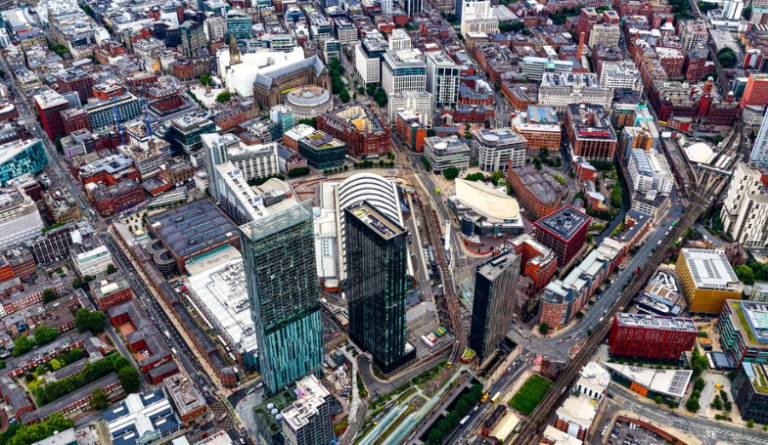
One of the other striking things about Manchester is the sheer amount of development. Cranes reach across the city skyline from every angle. Much of this is residential, which brings me to another important metric.
Manchester has attracted people to live in its center. The center population is currently estimated to be around 100,000 and estimated to grow to 250,000 by 2035. For context, in 1990, that number was closer to 500.
What’s particularly interesting is that this kind of growth is no longer something we simply observe — it’s something we can increasingly anticipate.
When you layer population growth with employment clustering, infrastructure investment, and mobility patterns, clear signals begin to emerge about where demand is forming and how it will evolve. These signals allow developers, planners, and businesses to move beyond reacting to growth and instead plan for it with greater precision.
A deeper understanding of demand
A growing residential base is one of the clearest indicators of long-term demand. But the real insight comes from understanding who those residents are and how they behave.
Are they students, young professionals, or families? Are they commuting daily, working hybrid, or staying local? Each group places very different demands on retail, dining, and leisure.
Today, demand is no longer measured by population alone. It’s understood through behavior; how people move through the city, where they spend time, and how their preferences shift over time.
Modern sales forecasting approaches combine demographic data, mobility patterns, and consumer behavior to predict how demand will develop at a highly localized level.
That level of understanding turns growth into something actionable – and a potential competitive advantage for those looking to understand what happens next for Manchester.
The buzz of a thriving city
Manchester has attracted the likes of Bank of New York, IBM, and Booking.com, while neighboring Salford has been the home of the BBC since 2006. Barclays employs thousands in the city, and global brands across industries have established major presences.
Clearly, being the location of our HQ, I’m going to have some biases towards Manchester, but it’s hard to ignore the level of activity across the city at any time of day.
Around lunchtime, the streets are busy with students and workers, and the range of dining options reflects that diversity. I can take surely the most British of lunchbreaks by queuing at Gregg’s, or I can head to Dishoom for a sit-down meal of Indian cuisine.
This isn’t accidental. It reflects a close alignment between supply and localized demand.
Today, that alignment can be measured and refined. By analyzing demographics, footfall patterns, cross-shopping behavior, and competitive dynamics, it’s possible to understand not just what is working, but why it works in a specific location.
These insights help shape decisions about tenant mix, site selection, and even how individual units are designed — ensuring that each space is matched to the demand it serves. And Manchester is doing it very well.
A city that evolves throughout the day
Into the evening, Manchester flexes. It retains its daytime population while attracting a different audience driven by leisure and experience.
This highlights a broader shift in how cities operate. Understanding when people arrive, where they go, and how long they stay has become just as important as understanding how many people visit.
As an example, pub and restaurant groups have reported that city center Thursday evening demand has strengthened as post-pandemic working patterns see commuters work from home on a Friday.
For retail and service businesses, these types of shifts translate into smarter staffing, better use of space, and concepts designed around peak demand windows. In many ways, this is where data becomes most powerful — not just describing activity but helping shape how a city functions hour by hour.
What comes next for Manchester
If the last decade has been defined by growth, the next phase will be defined by precision.
The volume of data available today — from mobility insights to consumer behavior to innovative emerging signals like geosocial — means decisions no longer need to rely on broad assumptions. They can be grounded in a detailed understanding of how people interact with the city.
This has several implications for Manchester’s next phase of development.
- More targeted development
New residential, retail, and mixed-use projects can align more closely with proven demand, rather than generalized projections. - Smarter expansion strategies
Businesses can hone in on the precise areas of opportunity by neighborhood, street, or even micro-location. This reduces the risk associated with development and improves long-term performance. - Continuous optimization
With the city’s change occurring at high velocity, it’s critical that retailers active in the market optimize and reoptimize regularly. Capabilities like forecasting models should be refreshed to reflect new behaviors, competitive dynamics, and macroeconomic conditions, ensuring decisions remain aligned with reality.
Ultimately, this is what separates sustained growth from optimized growth.
Manchester has already proven it can outperform. To sustain that success, businesses and city planners must stay the course, guided by a clear, data-driven understanding of demand.
That’s what will define the next phase of its development.