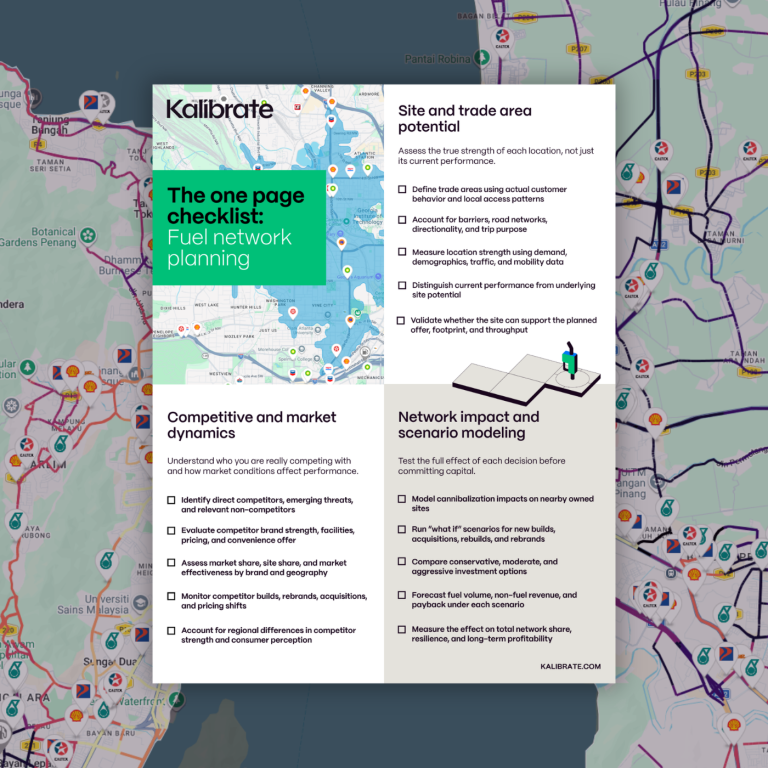
In March, The Vision Group Network, a networking forum for retail professionals, published an excellent report, Redefining the fuel of global roadside retail, as an output of its Global Convenience virtual meeting. You can read the full report here.
The themes identified in the report surface critical capability requirements to navigate a changing fuel retail landscape.
Technology investment must drive throughput
The report emphasizes a shift in mindset when it comes to technology. Investment must be pragmatic and purposeful — focused on solutions that directly improve throughput and operational efficiency, rather than innovation for its own sake.
It’s a great theme and network operators should align themselves as closely as possible with this principle. For example, predictive modeling allows retailers to quantify how changes to pricing, facilities, or site layout will impact fuel volume and in-store performance. Instead of relying on assumptions, decisions can be grounded in expected results.
Fuel price optimization is another key capability. By analyzing factors such as demand, competition, price elasticity, and seasonal variation, retailers can set prices that balance volume growth with margin protection. This is not radical change for most, but an absolute commitment to making precise, data-driven adjustments that improve performance without disrupting customer perception.
Combined with scenario modeling, these capabilities ensure that every technology investment — whether operational or strategic — is tied directly to improved throughput and return on capital investment.
The location challenge: future-proofing the network
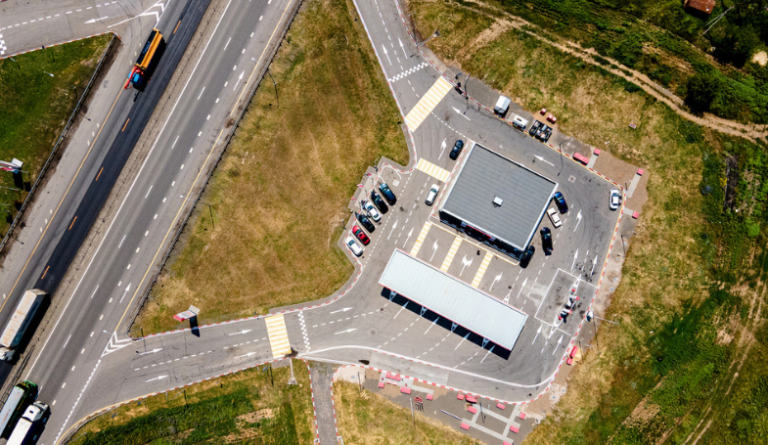
One of the most significant themes in the report is the growing mismatch between existing fuel networks and the future of roadside retail. As convenience, food, and alternative fuels become more important, many sites may no longer be fit for purpose. Some will need to be repositioned. Others may need to be exited altogether.
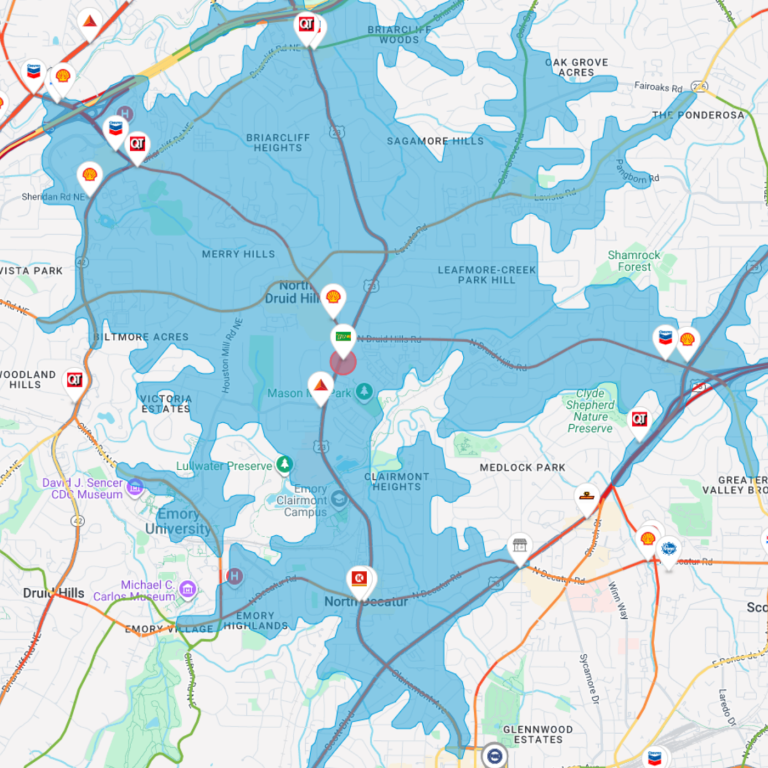
Understanding which is which requires a deep, objective view of site potential. Advanced modeling help retailers assess the true “dirt strength” of each site; its inherent ability to generate volume based on location and market conditions.
From there, frameworks like Kalibrate’s Performance Potential Quadrant (PPQ) analysis provide a clear segmentation of the network. Retailers can identify high-potential sites that are underperforming, as well as low-potential sites that may not justify further investment. This insight allows for targeted action, whether that’s upgrading facilities, enhancing the offer, or reallocating capital elsewhere.
Crucially, these decisions should be tested through “what-if” scenarios. Retailers can model the impact of adding a quick service restaurant, introducing EV charging, or redesigning a site layout — and understand not just the site-level benefit, but the effect on the wider network. This ensures that futureproofing is not just strategic, but measurable.
Capital allocation is becoming more complex
As the market evolves, capital allocation decisions are becoming more challenging. Retailers must weigh investment in growth against declining returns in certain areas, often under conditions of uncertainty and competing internal priorities.
By combining projected fuel and non-fuel revenues with capital and operating costs, retailers can evaluate opportunities on a consistent basis. This allows them to prioritize investments that offer the strongest financial and strategic return, while avoiding lower-impact initiatives.
Beyond individual sites, portfolio-level analysis provides a broader view of network performance. Kalibrate uses metrics such as market effectiveness and competitive benchmarking to help retailers understand how well their network is performing relative to competitors, and where investment will have the greatest impact.
This is where capital allocation becomes less about difficult trade-offs and more about informed prioritization, i.e., ensuring that every dollar invested contributes to long-term growth and resilience.
Site-level viability and network segmentation
A recurring theme in the report is the need for clear, decisive segmentation of the network. Retailers must be able to categorize sites into those to invest in, those to maintain, and those to divest.
Again, application of consistent frameworks to categorize each site based on its potential and actual performance, informs decision making. High-potential, low-performance sites represent the greatest opportunity for improvement, while low-potential, low-performance sites may be candidates for exit.
Retailers keen to take the data-driven view should identify the specific drivers of performance at each site. For example, a site may have strong location potential but be held back by poor facilities or weak merchandising. By isolating these factors, retailers can take targeted action to unlock value.
The result is a network strategy that is both precise and actionable, ensuring that resources – both analytical bandwidth and capital allocation – are focused appropriately.
Extending dayparts and maximizing revenue
The report identified that as fuel demand evolves, retailers are increasingly looking to extend dayparts and diversify revenue streams. This might include expanding foodservice, enhancing convenience offerings, or capitalizing on longer dwell times associated with EV charging.
However, these opportunities come with cost and complexity. Without a clear understanding of the potential return, there is a risk of over-investment or misalignment with customer demand.
Today, there are a wealth of capabilities like demand modeling and scenario analysis that address these challenges. Retailers should forecast the incremental revenue generated by new offers and assess the impact on customer behavior and visitation trends.
For example, modeling the addition of quick service restaurant or car wash allows retailers to understand both the direct revenue impact and the secondary effects on fuel and in-store sales. This ensures that decisions are not based on assumptions, but on quantified opportunity.
Managing a fragmented transition
The transition to the future of roadside retail will not be uniform. Different sites will evolve in different ways, depending on their location, market conditions, and customer base. There is no single blueprint for success.
For Kalibrate, that means supporting retailers in managing this fragmented transition through site-specific analysis and long-term planning.
Whether it’s shifting consumer behavior, new competitor activity, or regulatory developments, plans can be refined and re-forecasted to reflect the latest reality.
This flexibility is essential. It allows retailers to phase their investments, adapt their network over time, and avoid committing capital too early or in the wrong places.
Ultimately, managing the transition is not about making a single, transformative decision. It’s about making a series of informed, incremental decisions — each one grounded in data and aligned to a clear strategic direction.
Closing thought
The themes identified in this report have striking similarities with the topics of conversation we have with our clients every day. Across all these themes, a consistent message emerges. The future of roadside retail will be led by those with ability to make informed decisions — faster, and with greater confidence.
For Kalibrate, this means combining deep market data, advanced analytics, and practical industry expertise. Retailers should seek to understand true site potential, allocate capital more effectively, adapt to changing market conditions, and ultimately improve both volume and profitability.
In market conditions defined by complexity and change, these capabilities are not just incremental competitive advantage. They are requirements for success.