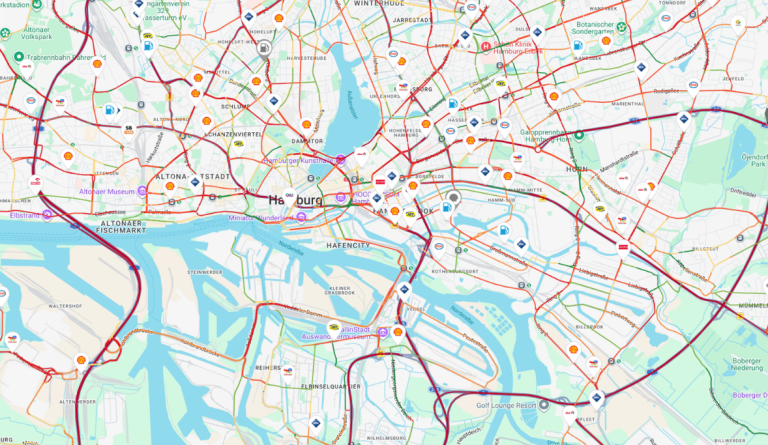
The future of fuel and convenience retail is often discussed in terms of electrification, changing mobility patterns, and the diversification of the forecourt. But what is actually happening at a market level? Are retailers fundamentally changing their business models, or are they adapting existing propositions to better meet evolving consumer needs?
Kalibrate’s latest survey of the Hamburg fuel and convenience market, comparing data collected in 2021 and 2026, provides an interesting perspective. It reveals a mature market undergoing consolidation, a convenience proposition increasingly focused on immediate consumption, and two distinct retail models capable of succeeding within the same competitive environment.
Perhaps most interestingly, the biggest change over the past five years has not been what drivers put into their vehicles, but what retailers put into the customer experience.
Fewer sites, more reasons to visit
Between 2021 and 2026, the number of operational fuel retail sites in Hamburg fell from 218 to 207, a reduction of 5%. Of the original estate, 206 sites remain operational, with 12 closures and just one new site entering the market.
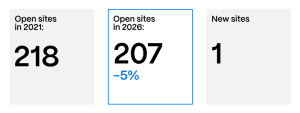
This is a market characterized by consolidation rather than replacement growth. For fuel retailers, the implication is that future growth will increasingly depend on extracting greater value from existing locations, making selective acquisitions, and identifying the relatively limited opportunities for new-to-industry development.
Yet while the physical estate has contracted, the proposition offered to consumers has expanded. Retailers are creating more reasons to visit their locations, with the most notable changes taking place inside the convenience store rather than on the forecourt.
From convenience retailing to convenience eating
Hamburg’s convenience stores are increasingly competing for breakfast, coffee, and lunch occasions. The availability of grab-and-go food has increased, hot drinks are now almost universally available, and bakery products remain a prominent feature of the market.
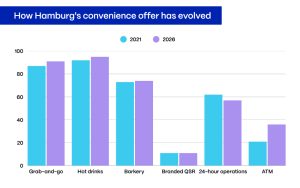
Interestingly, the penetration of branded quick-service restaurants (QSR) has remained unchanged at 11%. The evolution of foodservice in Hamburg is being driven by retailers developing their own food and beverage propositions rather than expanding through branded restaurant partnerships.
he shift from reheat to ready-to-eat is particularly significant. As retailers reconsider how they allocate space within their stores, traditional self-heated snacks and general retail merchandise are giving way to products designed for immediate consumption.
Another notable development is the increase in ATM availability, from 21% to 36% of sites. It serves as a reminder that diversification is not simply about following international retail trends. Understanding local consumer behavior and providing relevant everyday services remains an important part of building a compelling convenience proposition.
Two winning retail models in one market
One of the most interesting findings from Hamburg is that there is no single blueprint for success. Two distinct retail models have emerged: fuel-led efficiency and destination convenience.
Jet and HEM are representative of the fuel-led efficiency model, focusing on high-traffic locations, competitive fuel pricing, and relatively compact stores with a strong convenience offer. Aral and Shell are pursuing a more destination-oriented proposition, with larger stores, more services, and a greater emphasis on the premium customer experience.
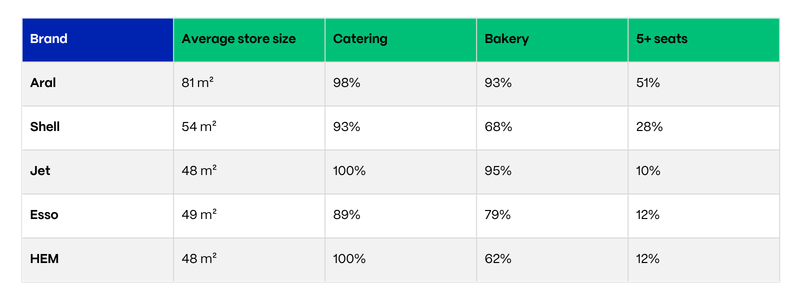
Aral leads on destination scale, with an average store size of 81 square meters and more than half of its locations offering five or more seats. Jet, meanwhile, demonstrates what can be achieved within a smaller footprint. Despite an average store size of just 48 square meters, 100% of its locations offer catering, takeaway food, and hot drinks, while 95% offer bakery products.
The distinction is important for fuel network planners. Increasing store size is not necessarily a prerequisite for improving the convenience proposition. How effectively a retailer uses its available space, relative to the customer missions it serves, is equally important.
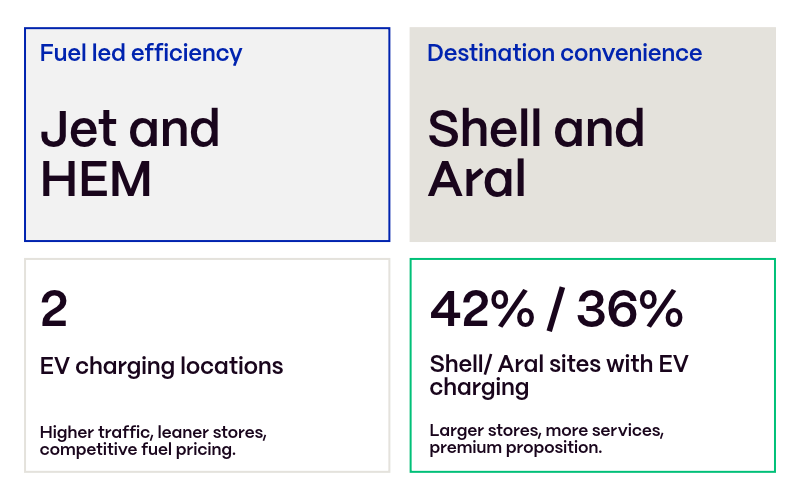
EV charging is present at 42% of Shell locations and 36% of Aral locations, while Jet and HEM have just two EV charging locations between them.
The concentration of EV investment within the destination convenience model suggests that electrification is being approached as part of a broader retail proposition rather than simply as an alternative to traditional fuel sales. Locations with more extensive foodservice, seating, and convenience facilities are arguably better positioned to capitalize on the longer dwell times associated with charging.
For network planners, the question is not whether every location should offer EV charging, but which locations have the characteristics necessary to support a commercially viable charging proposition.
Market dominance does not mean every site is fulfilling its potential
Aral, Shell, and Jet account for more than half of Hamburg’s fuel retail sites. Despite their considerable market presence, all three achieve a market effectiveness ratio above one, meaning they capture a greater proportion of market volume than their share of outlets.
However, market effectiveness only tells part of the story. Understanding how retailers perform relative to the underlying potential of their locations reveals further opportunities for growth.
In gasoline retailing, Aral, Jet, and HEM combine high-potential locations with strong operational performance. Shell, Esso, and TotalEnergies demonstrate opportunities to improve performance relative to their location potential.
The picture changes when looking at convenience store performance. Jet and Aral maintain strong positions, while HEM and Bonjour demonstrate opportunities to better capitalize on their underlying convenience potential.
These differences highlight the importance of assessing fuel and convenience performance independently. A location that is successfully capturing passing fuel demand may still have considerable untapped potential inside the store.
Where will Hamburg’s future growth come from?
Despite the maturity of the Hamburg market, opportunities for new-to-industry development have not disappeared. Kalibrate’s hotspot analysis, which simulates new fuel retail locations at major road intersections across the city, identifies areas where underlying location potential remains strong. Land availability, rather than an absence of market opportunity, represents a critical constraint.
Acquisitions and existing site optimization also offer routes to growth. Saturation analysis reveals that Star, Jet, and Esso sit within the market’s optimal growth zone, while TotalEnergies, Oil!, and HEM are approaching the critical mass required to unlock stronger market share gains. Shell and Aral have moved beyond the modeled saturation point, although Aral continues to outperform despite its scale.
For retailers considering acquisitions or investing in their existing estate, identifying high-potential, underperforming locations represents a particularly attractive opportunity. Understanding what is constraining performance, whether that is the facility, merchandising, pricing, or operations, enables retailers to direct investment toward the changes most likely to deliver incremental volume and revenue.
Three lessons for fuel network planners
Hamburg offers three important strategic considerations for fuel and convenience retailers operating in mature markets.
Consolidate around stronger locations. As markets mature, investment decisions should increasingly focus on the underlying potential of individual locations rather than simply growing the number of sites within a network.
Own the customer occasion. The evolution of foodservice in Hamburg demonstrates the importance of understanding why consumers visit a location. Breakfast, coffee, lunch, and everyday convenience services create opportunities to generate additional revenue and encourage repeat visits.
Match the retail model to the location. Efficient, high-volume fuel stops and premium, EV-enabled convenience destinations can coexist successfully within the same market. The challenge is identifying which proposition is best suited to each location, its customer base, and its competitive environment.
The future of fuel and convenience retail is unlikely to be defined by a single winning business model. Instead, success will depend on how effectively retailers understand their markets, recognize the potential of individual locations, and adapt their investment strategies accordingly.
Hamburg demonstrates that the strategic question is no longer simply one of fuel versus convenience. It is about understanding which proposition each location can, and should, support.