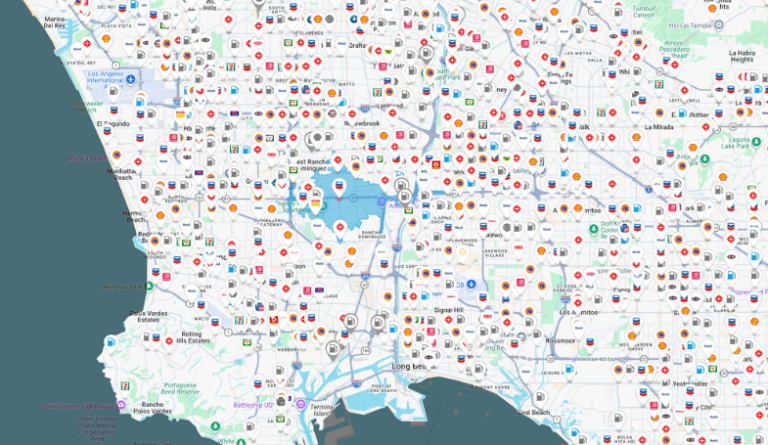
Kalibrate recently completed its 2026 survey of the Greater LA fuel and convenience market. If you’re interested in the dataset to support decision making either through standalone feasibility studies or Kalibrate Fuel Planning software, please get in touch with our team.
One of the strengths of Kalibrate’s market studies is the ability to compare trended data over time. Historical comparisons reveal not only how many sites have opened, closed, or changed ownership, but also how the competitive offer has evolved. Tracking changes in amenities such as foodservice, quick-service restaurants (QSRs), car washes, and other consumer-focused offerings provides valuable insight into how operators are adapting to changing customer expectations and pursuing new revenue streams.
By analyzing penetration rates and site counts across multiple years, stakeholders can identify shifts in market strategy, measure the pace of industry transformation, and better understand which concepts are becoming standard features versus emerging differentiators. These trend analyses help retailers, suppliers, and investors make more informed decisions based on observable market evolution rather than a single point-in-time snapshot.
The findings highlight how the Greater Los Angeles market has changed between 2023 and 2026, providing perspective on both overall market growth and the changing composition of the convenience retail offer.
Site count 2023 vs 2026
As with all mature markets, the pace of change is slow but it’s encouraging to see growth in the number of sites since Kalibrate’s last market study.
The growth of QSR
QSR penetration increased from 29.5% to 32.7% of open sites between 2023 and 2026, with the number of sites offering a quick-service restaurant growing from 1,320 to 1,482 locations (+162 sites). This growth reflects the continued importance of foodservice as a traffic driver and revenue generator for convenience retailers. QSR partnerships increase visit frequency, attract meal occasions beyond fuel purchases, and help operators differentiate their sites in highly competitive markets. Given the higher capital requirements, franchise agreements, and site-layout considerations associated with QSR development, growth tends to be incremental, making the increase in penetration noteworthy.
Deli
Following the expansion of QSR, deli penetration experienced substantial growth, increasing from 4.5% to 25.0% of open sites over the same period. The number of sites offering deli expanded from just 201 locations in 2023 to 1,131 locations in 2026, an increase of 930 sites. This dramatic expansion suggests operators are increasingly investing in prepared food and fresh offerings to drive higher-margin sales and capture additional meal occasions. Customers demanding more from their visits and operators are responding. Compared with QSRs, deli programs often require lower capital investment and can be integrated into a wider range of store formats, making them a more accessible foodservice strategy for many sites.
ATM, car wash, and EV charging
ATM availability experienced one of the largest increases outside of foodservice, growing from 16.9% to 25.4% of open sites. This suggests operators continue to see value in providing convenient access to cash and related financial services, particularly in locations serving high traffic volumes and diverse customer segments.
Car wash penetration increased modestly, reflecting the capital-intensive and site-dependent nature of the amenity. While growth was limited, car washes remain an attractive source of recurring revenue and customer loyalty.
EV charging remains a small but growing component of the market, with penetration increasing from approximately 1.0% to 1.5% of open sites. Although adoption is still limited, the growth reflects retailers beginning to position their networks for the evolving vehicle fleet and longer customer dwell times.
Learn more
Explore our gas station feasibility service here – note, sites in surveyed markets (like Greater LA) are typically priced cheaper and are delivered faster than those that require a new survey.