
EV charger location strategy
Vehicle charging happens at a more diverse range of locations than conventional fueling. Our EV charging strategies help you:
- Identify demand for EV charging
- Understand utilization rates prior to charger deployment
- Quantify fuel demand erosion by EV adoption
Navigating the change with your EV charging station location strategy
Navigating the change with your EV charging station location strategy

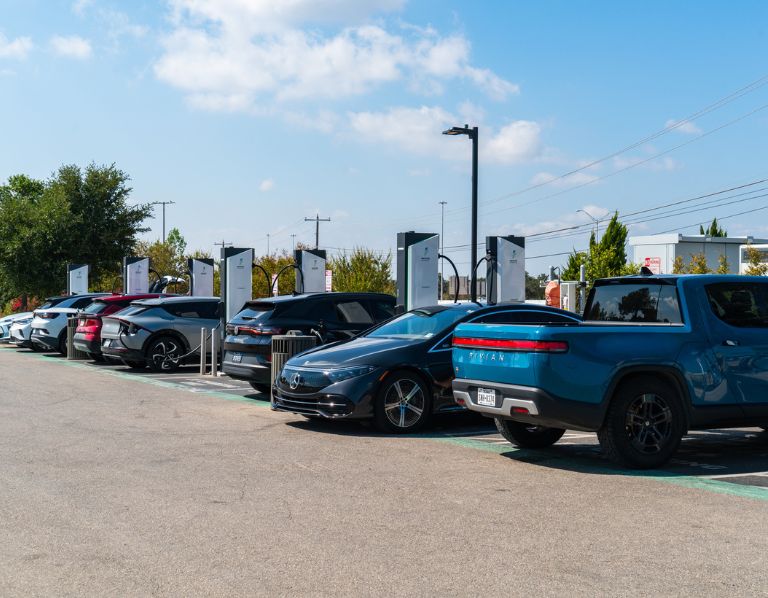
Understand where and when drivers will make the switch
Levels of EV adoption vary significantly from country to country – and often more within individual markets.
Understanding local EV demand is essential when planning your EV charger location strategy. Usage can vary significantly by area, so businesses should assess how many customers, employees or tenants drive EVs to better predict current and future charging needs.
Kalibrate uses demographic and customer segmentation data to map where EV drivers are relative to your locations, and how insight supports investment decisions.
Identify when fuel volumes will be eroded by EV adoption
Use Kalibrate’s EV adoption profile alongside our proprietary mobility and traffic insights to understand when and where fuel volumes will be impacted.
This gradual shift reduces demand at fuel stations, encouraging businesses to adapt by introducing an EV charging strategy and upgrading infrastructure to maintain customer traffic and future-proof their locations.
If the forecourt is viable for installing chargers, use demographic segmentation to discover the retail or food and drink offer to suit EV drivers at the current stage of adoption.
Invest where you get returns
Kalibrate has developed an EV utilization model to help businesses forecast the ROI for EV chargers and ensure profitability.
By identifying where drivers already stop, refuel, or spend time, businesses can better predict EV charging demand and place chargers in locations with the highest potential usage, helping boost ROI and improve customer experience.
By combining advanced analytics, market intelligence, and location data, our agile EV charger strategy helps businesses forecast demand, optimize site selection, analyze profitability, and make data-driven decisions.
Ready to get started with your EV charger location strategy?
Benefit from powerful location intelligence for EV charging. Speak to a member of our team to learm more

Additional resources
Read more Kalibrate insights and best practices in our blog.

Ready to supercharge your EV strategy?
What are EV charging strategies?
Successful EV charging strategies are built around four key areas: transparent pricing that meets customer expectations and local regulations, choosing the right charger types for your location and usage needs, delivering a smooth and reliable user experience with easy payment options, and ensuring compliance with sustainability, safety and accessibility standards. Together, these elements help businesses attract more drivers, control operating costs and encourage repeat usage.
What are the best locations for geo-targeted EV charging optimization?
- Highway corridors: Install chargers along major routes to support long-distance EV travel and road trip charging.
- Retail and shopping centers: Provide convenient charging for customers during 30–60 minute shopping visits.
- Hotels and hospitality venues: Offer overnight charging for guests staying at the property.
- Workplaces and business parks: Enable all-day charging solutions for employees while they work.
- Multi-family properties: Support residents without access to home charging in single-family homes.
- Fleet depots: Create centralized charging hubs for delivery, logistics and service vehicle fleets.
- Fuel stations: Expand traditional refuelling sites with EV charging to meet changing driver demand.
What EV charging strategies produce the best results?
Effective EV charging stations location planning starts with clear, customer-friendly pricing that reflects local costs, alongside selecting charger types that match how each site is used. Success then relies on delivering a smooth user experience with easy payments, high reliability and full compliance with sustainability, permitting, accessibility and safety standards. Profitability is driven by charger utiliszation, cost structure and a balanced mix of revenue streams such as charging fees, in-store sales, partnerships and incentives. When executed well, an EV charging strategy can enhance site performance while positioning businesses for strong, sustainable growth as demand continues to rise.
How do fuel retailers and convenience stores benefit from an EV charging stations location strategy?
As EV adoption continues to grow and fuel margins stay tight, installing EV chargers can create new revenue opportunities through charging fees and increased in-store spending during longer customer dwell times. Convenience stores and fuel retailers are well positioned to benefit thanks to their prime locations, often seeing increased foot traffic, higher sales and stronger sustainability credentials after introducing charging facilities. This makes EV charging a valuable long-term investment for future-proofing sites and attracting modern drivers.