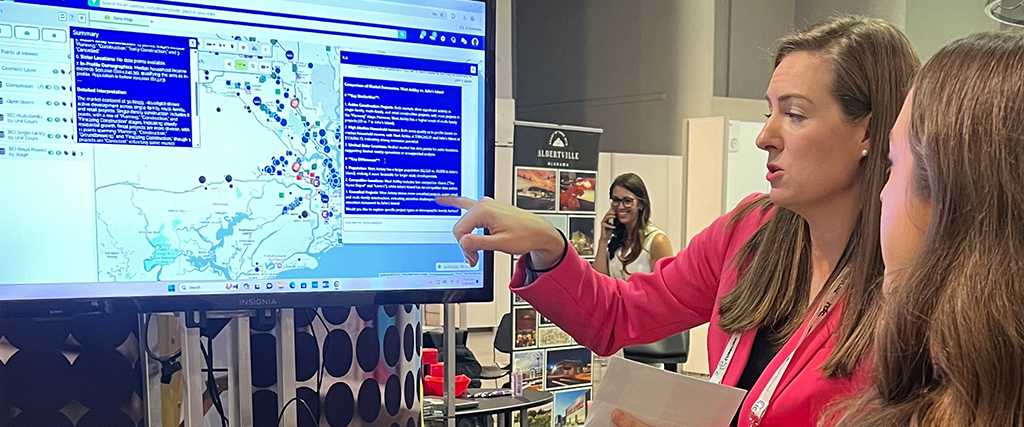
In this blog series, we take a closer look at how our team supports our clients in achieving their strategic objectives. In some organizations, it might be going ‘above and beyond’ to get the job done – but we just call it ‘the Kalibrate Standard’.
This edition features Nqobile Mofokeng, Customer Success Consultant.
Tell us about your background before your joined Kalibrate
My professional journey began in accountancy, but I soon discovered a real passion for strategic planning. I was fortunate enough to explore this interest within my family’s business, which specialized in providing strategic consultancy to various government departments in South Africa.
Around twenty years ago, I made the leap into the oil industry, taking on various roles, including that of strategy manager for AirBP Africa. My time at BP, where I spent a decade, proved to be incredibly formative. During my tenure as Executive Assistant to the CEO, I was introduced to the intricacies of retail network planning and had my first experience using what is now the Kalibrate tool (then known as MPSI).
After my years at BP, and three beautiful daughters later, I joined Puma Energy as a regional network manager. My hands-on experience with Kalibrate during market planning and execution was instrumental in securing this role.
What is your role?
As a Customer Success Consultant, my role centers on championing our clients’ interests within Kalibrate. I act as the bridge between our Kalibrate Planning product, consulting services, and those who use them. It’s my responsibility to ensure Kalibrate stays closely aligned with the realities and challenges our clients encounter daily.
Supporting clients through training is also a key part of what I do, making certain they are proficient with the tool and able to take advantage of its full range of features. I strive to ensure that clients consistently recognize the value our tool brings to their operations, addressing any queries or concerns promptly to reinforce this.
Ultimately, I see it as my duty to guarantee that our product continues to meet client needs effectively and enables success in their market.
How does your prior experience influence your work with clients?
Having previously sat on the client side, both in operational and strategic capacities, I bring a unique perspective. My extensive tenure in the industry has allowed me to build strong relationships not only within South Africa but right across Africa.

My expertise goes beyond simply understanding how the Kalibrate tool functions; I can relate to a diverse range of stakeholders and appreciate the internal challenges they face, from navigating company politics to overcoming barriers at every level. Because I recognize the realities of impatient capital and departmental competition—factors that often foster siloed thinking and short-term decisions—I am better placed to recommend solutions that are sensitive to these complexities.
I am also able to advise clients on the practicalities of implementing Kalibrate plans after our consulting engagements conclude. This insight is particularly valued, as it helps clients refine their approach to execution.
I believe clients welcome working with someone who genuinely understands their day-to-day reality, trusting that I will represent their interests and advocate for change within Kalibrate if it will benefit their overall outcome.
What types of questions are your clients looking to answer?
Kalibrate serves a broad cross-section of users, and each group has distinct interest in how they apply our data. Executives—focused on protecting and growing shareholder value through both organic and inorganic interventions—are typically interested in their current S-curve position, potential M&A targets, the optimal market participation strategy, and the unconstrained potential of their retail network.
Mid-level management, by contrast, want to understand how best to deliver the growth or profitability targets set at the strategic level. They may be weighing whether to prioritize improving operational fundamentals, which are capex light or to invest capex aggressively—either by upgrading existing facilities or by adding new sites to the network. Timing is often critical, as these options can require significant capital investment and may not yield immediate returns.
Operational area managers tend to ask more site-level questions: how to improve trade-area positioning, which levers to pull to increase site performance, and what interventions will deliver the greatest impact at individual locations.
The power of the Kalibrate tool is in answering these different questions for a diverse audience—connecting strategic intent to tactical decisions and day-to-day execution.
What value do you think Kalibrate adds to its Clients?
I regularly ask this question of our clients. The common answer is that they appreciate having an environment where they can forecast and assess the volumetric impact of alterations, potential investment sites e.g. takeovers and new to industry sites.
Although Kalibrate’s strength does lie in this area, I personally find that some of the even more powerful features are little known among our client community. For example, the immense value of the 7 Elements and quadrant analyses, which to me in my former role as a network planner were very useful.
A differentiator for Kalibrate is in answering the question the client has not known to ask from us. It has been exciting to grow closer to our clients over the past year and to come up with solutions such as the AI Analyzer, which helps them draft more robust investment proposals for their internal approval processes.
An underrated benefit of using planning tools is the ability to avoid mistakes; not expending capital in areas that won’t deliver a viable return. This is the type of capability you really notice when it’s not there. I’d consider this high up the value list for our clients, even if it’s not something they consider every day.
What type of client would you recommend Kalibrate to?
The client that would benefit from Kalibrate is one that is ready to tell itself the truth. A management team that is willing to clear the slate of all assumptions that drive their values and internal processes. They need to disrupt thinking, rethink priorities, look for new sources of value and objectively place the overall health of the business above individual agendas and nostalgic thinking.
Recognizing there’s room for improvement in the network – and all networks have room for some improvement – is the vital first step. Embracing what the data is telling you then acting upon it requires buy-in from every tier involved in the decision making.
What lessons have stuck with you over the years?
A company remains number one by thinking like the number two. Consistent leads actively seek to better their own records. Disruptive and transformative thinking is encouraged, embraced as part of the culture and most importantly, rewarded.
Clarity on strategy and visible financial support in the implementation thereof is paramount. You can tell the lived strategy of any company through analysing their financial statements – when this deviates from the stated strategy, then it becomes obvious that the company is likely to run out of runway quickly. Just like in one’s personal life, if one’s resources are employed in a manner different to the overall intent, then before long, one finds oneself at places very different to those pasted on one’s vision board.