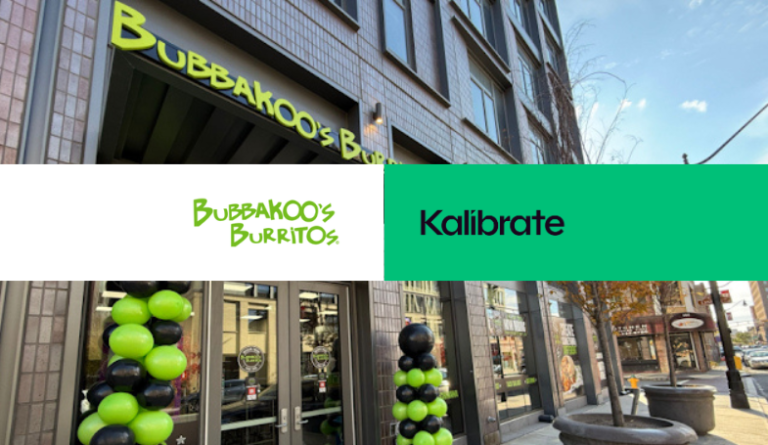
Founded 18 years ago at the Jersey Shore, Bubbakoo’s Burritos is a Mexican fusion burrito concept with roughly 150 locations up and down the eastern seaboard – about 97% of which are franchise-operated. The brand’s sweet spot has been working with single-unit operators and growing them into multi-unit operators over time.
With a corporate team of just 14 people, CEO Chris Ives still directly oversees development. We sat down with Chris to talk about how Bubbakoo’s evaluates growth opportunities, where location intelligence fits into a lean operation, and what’s changed since partnering with Kalibrate.
What makes a great location for Bubbakoo’s?
Chris Ives, CEO: Shared pads, outparcels, and end-caps are preferred – in-line is acceptable only with strong street visibility. We want full turn access from both main and side arteries. In short, we want to be seen and easily accessed, not buried in a center. We target 1,200–1,800 sq ft with a minimum 20-foot frontage and at least 15 parking spots.
What were the biggest challenges your team faced when evaluating new locations before working with location intelligence tools?
CI: Time. We had to rely on getting data from our brokers. Internally we were relying on spreadsheets, gut instinct, and broker relationships rather than unified demographic and traffic data.
That created challenges around speed and identifying whitespace. A lot of the time it was reactive – a franchisee would call and say, “This is where I’m interested.” Now we can flip that and say, “Here’s where we’ve identified opportunities, and here’s where we think you should be within that market.” It lets us be more pointed about where we should be.
What led you to bring on a location intelligence platform?
CI: Growth. In order to grow quicker we needed actionable data that we can share with our franchisees. We wanted to onboard a site selection and forecasting tool to give us better internal data points – especially for our real estate committee discussions.
How does your team use Kalibrate day to day?
CI: I use it daily because I’m on calls daily. Every Wednesday we have a development call that covers pipeline and real estate, and the platform is part of that. The platform is still relatively new for us, so we’re still learning the forecasting side, but the Competitive Insights have been a really strong leading indicator.
How are you using mobility data in Competitive Insights?
CI: We benchmark the co-tenants we like to be near and look at how they’re performing with Competitive Insights. When I’m evaluating a site, the QSR data points and co-tenancy picture are what I go to first.
That’s also where the reporting has been a big level up for us. We now have a professional package we can put in front of a franchisee that includes revenue forecasting before they sign a lease, the reasoning behind why we’re approving the site, and then when it’s time to open, local store marketing recommendations – here are the businesses, organizations, and places you should be engaging with after you open.
How does location intelligence help in the franchise sales process?
CI: It helps early in the conversation. If a lead comes in from somewhere like North Vernon, Indiana – a market I know nothing about – I can go in before the call and start evaluating whether it looks like a real opportunity and where we should actually be within that market.
That lets me have a much more productive conversation with someone who’s local and knows the community. Instead of just reacting to whatever real estate gets sent over, I have a starting point.
There’s still a big human element to real estate, though.
CI: Huge. Data is great, but data is also data. There are real, tangible things that go into real estate – traffic patterns, intersections, visibility – that still require boots on the ground. You have local operators who’ve been in that community forever and they just know it better. So it’s a combination of both.
Where have you seen the biggest impact so far?
The reporting. That’s been the biggest win. It’s really leveled up how our development and marketing teams work together around a site, and how we communicate with franchisees throughout the process.
Now we have a professional package we can put in front of a franchisee – here’s the revenue forecasting before you sign the lease, here are the reasons why we’re approving the site. And then when we go to open up a shop, here are some LSM recommendations – the local businesses, organizations, and places you should be hitting after you open to engage with.
That continuity from pre-lease through pre-opening has been the biggest win for us. Just the overall professionalism of the reporting.