For decades, fuel retailers have evaluated sites primarily through the lens of fuel throughput. If a location could deliver strong volumes, it was considered a good investment. Network planners would assess traffic counts, competitive density, and trade area demand before estimating how many gallons a site could realistically sell.
In a market where fuel was the primary revenue driver, this approach made sense.
But the economics of fuel retail are evolving.
Margins on fuel remain tight, consumer expectations around convenience and food service continue to rise, and the energy transition is reshaping long-term assumptions about vehicle fueling. At the same time, many forecourts sit on highly valuable parcels of land in areas that have experienced significant commercial and residential growth over the past several decades.
As these trends converge, an important strategic question is emerging for fuel retailers and network planners:
Should fuel retailers begin thinking more like real estate developers?
Increasingly, the answer is yes. The companies that will thrive in the future of fuel and convenience retail may be those that view their networks not just as fueling infrastructure, but as portfolios of high-value real estate assets capable of supporting a wide range of retail and mobility services.
The overlooked value inside many fuel networks
Most fuel retail networks were built gradually over many years, often through a mix of acquisitions and new site development. While each location was originally chosen for its fuel demand potential, many of these sites are now positioned on prime commercial real estate.
Busy intersections, commuter corridors, and highway access points—locations that once drove fuel volumes—also tend to attract broader retail demand. Over time, surrounding neighborhoods expand, new development appears, and economic activity increases. What began as a practical fueling location may eventually become a highly valuable commercial property.
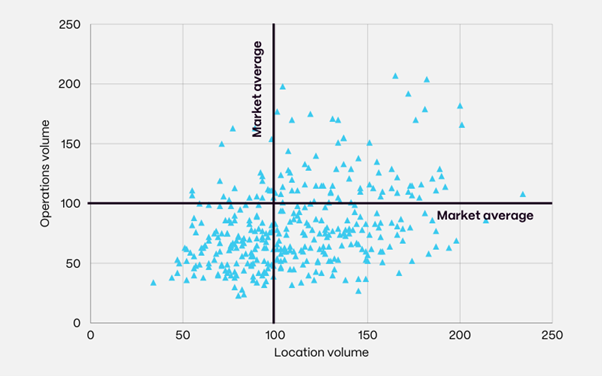
Despite this, many retailers still evaluate their sites primarily by operational metrics such as fuel volumes, margin per gallon, and convenience store sales. These indicators remain critical, but they do not always capture the full value of a location.
When viewed through a real estate lens, each site represents a strategic asset whose value may extend far beyond its current fuel performance.
For example, a location may offer:
- Strong retail demand from surrounding residential areas
- High visibility at a key intersection or commuter corridor
- Land suitable for site expansion or redevelopment
- Opportunities to add complementary retail services
- Long-term value as mobility infrastructure evolves
Recognizing this hidden value can fundamentally change how retailers approach network planning and long-term investment decisions.
The forecourt is becoming a retail platform
Another major shift in the fuel retail industry is the growing importance of non-fuel revenue. In many markets, convenience stores, food service offerings, and ancillary services contribute a substantial share of site profitability. Fuel remains the primary driver of traffic, but it is increasingly the retail experience that determines overall performance.
Historically, many networks applied standardized designs to new sites, focusing on pump count, canopy layout, and a consistent convenience store format. While this approach simplified operations, it did not always maximize the potential of each location.
Today’s consumers expect more from a forecourt visit. High-quality coffee programs, fresh food offers, and well-known restaurant brands are becoming important differentiators in competitive markets.
The most innovative operators are already considering a wider range of services to maximize revenue opportunity.
- Quick-service restaurant partnerships
- Differentiated convenience store concepts
- EV charging bays
- Parcel lockers
- Branded car wash
Designing sites around the needs of the surrounding community increases the appeal of the location and diversifies the range of pull factors beyond solely fuel.
Taking a data-driven approach to optimizing the site based on local demand significantly improves site performance and return on investment.
Managing a network like a real estate portfolio
Adopting a real estate mindset also encourages retailers to view their network at the portfolio level. Instead of treating every site as a uniform operational asset, companies can segment their locations according to strategic role and long-term potential.
Some sites may be positioned in rapidly growing areas where redevelopment or expansion could significantly increase value. Others may serve as stable operational assets that reliably generate fuel and convenience store revenue without requiring significant capital investment.
Operators should classify their sites into strategic categories such as:
- Growth locations — sites with strong market demand and redevelopment potential
- Core sites — stable assets that consistently generate reliable fuel and retail revenue
- Optimization opportunities — locations where targeted investment could unlock additional value
- Exit candidates — sites where declining demand or poor location limits long-term potential
Taking a portfolio-level perspective helps retailers allocate capital more strategically and maximize the overall value of their network.
The energy transition reinforces the importance of location
The shift toward electric vehicles and alternative energy infrastructure further highlights why location strategy is becoming so critical.
While the timeline for the energy transition varies by region, it’s clear that mobility’s next phase of evolution is well underway. Some sites will incorporate EV charging alongside traditional fueling, while others may transition toward entirely new mobility services.
In this environment, the strength of the underlying location becomes the most important factor determining long-term value.
Retailers increasingly need to consider:
- Future EV charging demand
- Population and traffic growth trends
- Retail demand within the trade area
- Competitive infrastructure developments
- Long-term changes in mobility patterns
A well-positioned site on a busy commuter route or within a growing urban area will remain valuable regardless of whether customers are purchasing gasoline, charging an electric vehicle, or stopping for food and convenience retail.
Rethinking the role of fuel network planning
The future of fuel retail will require a broader view of what network planning really means. Rather than focusing exclusively on fuel throughput and competitive positioning, planners must increasingly consider the full range of factors that influence site value.
Location intelligence, consumer behavior insights, demographic trends, and competitive analysis all play a role in understanding how a site can perform—not just today, but over the next decade.
Frameworks such as the 7 Elements for Fuel and Convenience Retail Success help retailers evaluate site performance across multiple dimensions, including location strength, brand impact, facilities, merchandising, pricing, and operations.
Fuel retailers that embrace this broader perspective will be able to unlock new revenue streams, strengthen their retail propositions, and build networks that remain resilient even as the industry evolves.
In many ways, the next generation of fuel retailers will look less like traditional energy distributors and more like strategic developers of high-value retail locations.
Unlocking the full value of your network
Understanding the true potential of each site requires more than intuition. It requires detailed market data, sophisticated analytics, and the ability to model how different investments and operational changes will affect network performance.
This is where advanced fuel network planning software can play a critical role.
By combining location intelligence, consumer demand modeling, and competitive analysis, retailers can evaluate not only how their sites perform today, but how they could perform under different scenarios—whether that involves expanding retail offerings, introducing EV charging infrastructure, or repositioning sites within the broader network strategy.
Kalibrate Fuel Planning helps retailers take exactly this kind of strategic approach. By analyzing site performance, location strength, competitive dynamics, and consumer behavior, Kalibrate enables planners to make more informed decisions about where to invest, how to optimize existing sites, and how to unlock the full value of their network.
Because in the future of fuel and convenience retail, success may depend not just on selling fuel—but on understanding the true value of the locations whether it’s retained, sold to fund investment elsewhere, or optimized through data-driven decisions.