One of the core ideas that underpins NACS is William Gibson’s line, the future is already here, it’s just not evenly distributed. You see elements of the future everywhere, but they’re particularly prominent in China, and seeing them operating at scale is powerful.
This isn’t a how to ‘copy China’ piece. It’s a practical attempt to separate what we think will travel internationally over the next five to ten years, from what feels distinctly local and unlikely to translate widely anytime soon. That thread, what will travel and what won’t, is the lens for everything below.
Coffee everywhere: When a category becomes a baseline
Shanghai has the highest density of coffee outlets in the world, and you feel it immediately. Coffee shows up not just in convenience stores and cafés, but in bicycle shops, shared workspaces, high‑end leather goods stores, and even specialist sleep apnea clinics. Prices range widely from 7 RMB to 34 RMB and above.
In that environment, coffee stops being differentiation and becomes an expectation. The pressure shifts to experience, identity and intent. When a non‑coffee business sells coffee, it’s often a deliberate tool to increase dwell time and footfall, not a category play.
What will travel is the lesson: as categories saturate, generic offers disappear and differentiation moves from product to experience. What won’t necessarily travel is the exact mix of unexpected outlets selling coffee, that’s shaped by local density and culture.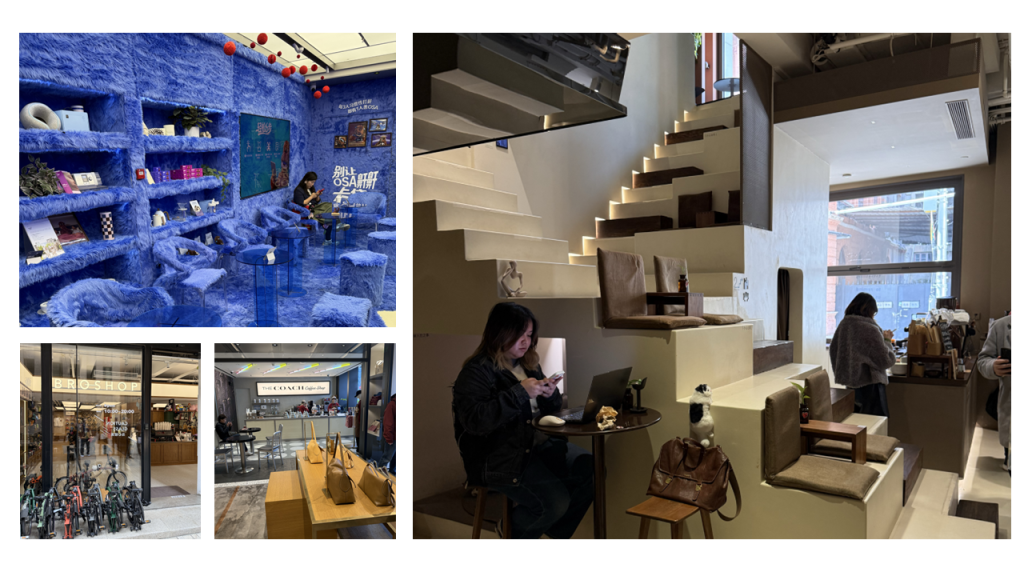
Precision of offer: Meeting the customer at the pump
One of the clearest differences we observed in China is the much lower conversion from forecourt to store than we would typically expect to see in many other markets. In this context, traditional assumptions about footfall simply don’t hold, and operators have adapted accordingly.
Rather than relying on customers to step inside, many are bringing the product closer to the vehicle. Between pump islands, the forecourt offer is extensive. Bulk water, car care products, low‑end gifting baskets, and even large quantities of cigarettes are displayed openly to capture impulse purchases without requiring customers to leave their cars.
This feels distinctly Chinese, and is almost certainly enabled by a very low crime environment. In most other markets, the potential for shrinkage would make this approach financially unviable. The execution may not travel, but the underlying logic does. In low cross‑shop conditions, convenience is redefined as reducing friction in the moment, even if that means moving the offer to the customer rather than the customer to the offer.
Once customers do step inside, the offer shifts again, and this is where the precision becomes most apparent.
In‑store ranges reflect clearly defined and sometimes contrasting missions. On one hand, there is a strong focus on health and functionality. Liquid salads, protein‑led options, and better‑for‑you products are positioned as everyday choices, aligned to wellness‑on‑the‑go behaviors. These aren’t niche offers, they are normalized, visible, and treated as part of the core proposition.
At the same time, there is space for indulgence. The desire to enjoy a small “tipsy moment” is catered for through carefully curated alcohol ranges, often tied to gifting, celebration, or social occasions. High‑end gifting alcohol, premium packaged selections, and curated gift boxes, even gold bars, sit comfortably alongside everyday essentials.
This contrast is deliberate. The strongest operators aren’t trying to smooth out these differences, they’re leaning into them. They recognize that customers move fluidly between restraint and reward, between health and indulgence, sometimes on the same day.
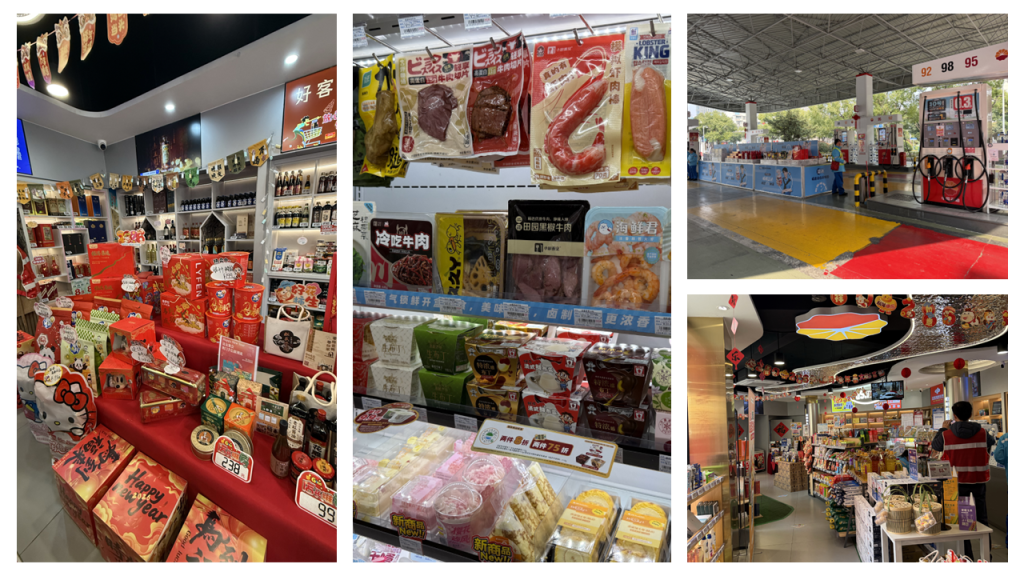
Not all of this will translate directly. High‑end gifting culture expressed through convenience retail is deeply rooted in local norms, and many of the specific products we saw won’t appear widely in Europe anytime soon.
What will travel is the thinking.
Precision of offer isn’t about carrying fewer SKUs, or chasing novelty. It’s about being explicit about the moments you’re serving. Buying health. Enjoying a small reward. Solving an immediate need. Marking an occasion. Each part of the range earns its place by serving a clear purpose.
In markets where traditional conversion models are under pressure, this level of precision becomes a strategic advantage. It allows retailers to remain relevant without trying to be everything at once.
Going vertical: Maximizing the footprint
In dense urban areas, land economics push operators upwards. We saw upper floors used as dark stores that expand a tight in‑store range of roughly 700 SKUs to 4,000+ SKUs, supported by strong delivery demand. That model works because it’s grounded in behavior and volume.
Other formats go further, stacking cafés, seating, retail and services. Some succeed, others don’t. One residential location added a café and roof terrace that didn’t attract sustained use. Rather than leave space idle, part of the building is rented by Pokémon to give people a dedicated space to play and compete. That feels culturally specific, but the broader idea, monetizing underused space, could translate in other dense cities.
Where space allows, fuel station operators are also adding automated car washes, EV battery swapping machines, rest areas and small gyms for drivers, ways to capture dwell time as mobility behavior shifts.
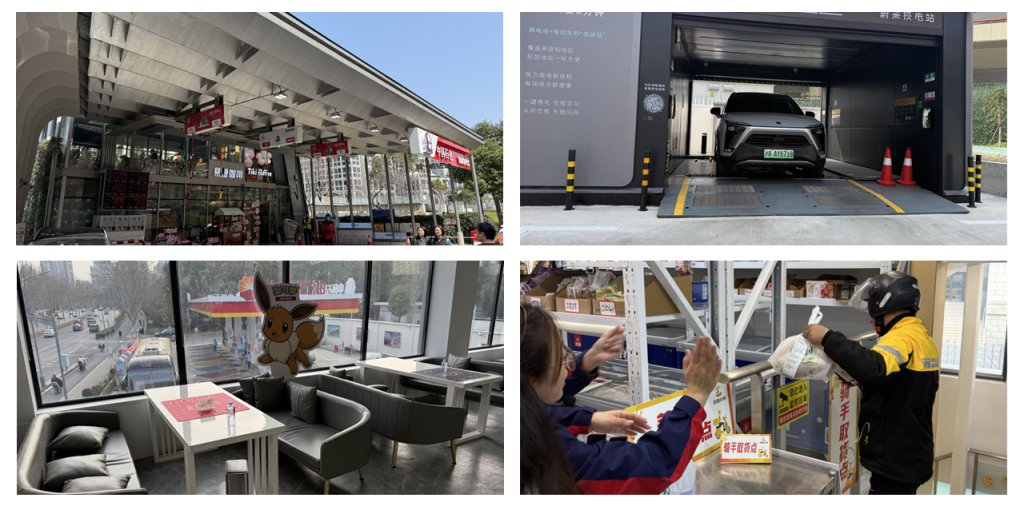
One of the most compelling examples we saw was Sinopec No.1, which has been completely redeveloped from a traditional petrol station into a riverside destination. What makes it particularly interesting is that this wasn’t about chasing volume. It’s a clear example of how a highly constrained urban site can be reimagined into a flagship, insight‑led and potentially profitable location.
The pumps have been removed and replaced with drop‑down nozzles, freeing up valuable space on a small footprint site. That space has been repurposed deliberately, including a first‑floor café with river views, turning what was once a purely functional stop into a place people actively choose to visit.
This feels like a blueprint rather than a one‑off. Not every market will replicate the exact format, but the principle is highly transferable. Older, space‑constrained sites don’t need to be written off as legacy assets. With the right insight into customer missions and the courage to rethink layout and use of space, they can be transformed into destination locations that play a very different role within the network.
What will travel is the thinking: maximizing the full potential of a location rather than defaulting to throughput metrics alone. What may not travel as easily are the specific economics and regulatory conditions that make such radical redesigns viable in dense Chinese cities.
What will travel is the mindset: treat space as an asset to be reconfigured as missions change. What may not travel is the specific economics that make vertical expansion so easy in certain cities.
Depth of relationship: Trust, emotion and delivery
A recurring theme was the Gen Z challenge. Many expected life to be easier than it has turned out to be. Despite pressure, they will still pay a premium for the right experience, and they will pay for delivery when it fits their lives. What they won’t tolerate is friction or irrelevance.
The best retailers build emotional connection through social platforms, then link it back to commerce. FamilyMart’s short‑form dramas are a great example, entertainment first, distributed at scale, with coupons embedded to buy the featured products.
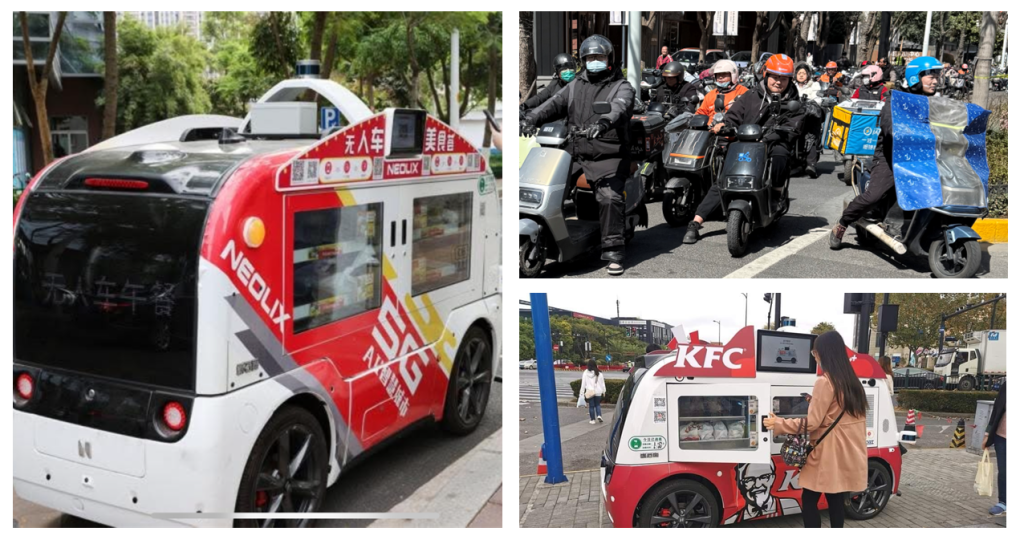
Delivery is part of the relationship as much as the offer is. Two‑wheel couriers, a sea of blue and orange helmets on the road, provide flexibility and scale, while providers like Neolix roll out autonomous vehicles to improve speed and consistency. Exactly how autonomy scales will vary by market, but the expectation for fast, predictable fulfilment will travel.
What will travel, and what won’t
We see a lot of the future in China, and much of it is transferable. Precision of offer, better use of footprint, proximity as the new convenience, cohesive digital experiences, and emotionally resonant engagement are already appearing elsewhere and will become more common globally over the next five to ten years.
Other elements are deeply local. High‑end gifting culture expressed through convenience retail, gold bars on shelves, and some rooftop‑terrace concepts are unlikely to show up widely in Europe anytime soon.
The value in trips like NACS APAC is separating signal from novelty. The goal isn’t to replicate formats, it’s to recognize what will travel, build the capabilities early, and be honest about what won’t.
Learn more about our fuel and convenience planning solutions.